

How to Brew Coffee on Site: A Job Site Coffee Guide
Table of Contents
- What You'll Need Before You Brew
- How to Brew Coffee on Site: Step-by-Step
- Portable Coffee Makers for Job Sites: Which One Fits Your Setup
- How to Keep Coffee Hot on the Job
- High Caffeine Coffee for Night Shifts
- Common Mistakes to Avoid When You Brew Coffee on Site
- How to Keep Coffee Hot on the Job
- High Caffeine Coffee for Night Shifts
- Common Mistakes to Avoid When You Brew Coffee on Site
- Frequently Asked Questions
Last Updated: September 15, 2026
What You'll Need Before You Brew
Good coffee on a job site comes down to four things: hot water, the right grind, a consistent ratio, and gear that survives a truck bed. This guide from Blue Collar Brewing walks through how to brew coffee on site with equipment that holds up, whether you're pouring over a tailgate at 5 a.m. or setting up a thermos station in a break room.
The biggest mistake crews make is treating on-site coffee like a convenience problem instead of a process problem. To beat gas-station coffee, control water temperature, grind size, and ratio, the same variables a café controls.
Here's what earns a spot in your kit:
- Heat source: Jetboil, camp stove, or a 12V kettle for the truck
- Kettle: Gooseneck if you're pouring over; any pot works for immersion methods
- Grinder: A hand burr grinder beats blade grinders every time
- Brewer: Pour-over cone, French press, AeroPress, or a moka pot
- Scale: A small digital scale gets you a repeatable coffee-to-water ratio
- Filtered water: Tap water at a job site is often the real problem, not the beans
- Thermos: Vacuum-sealed, not foam-lined
How to Brew Coffee on Site: Step-by-Step
The core method: heat water to the right temperature, measure coffee by weight, and control contact time.
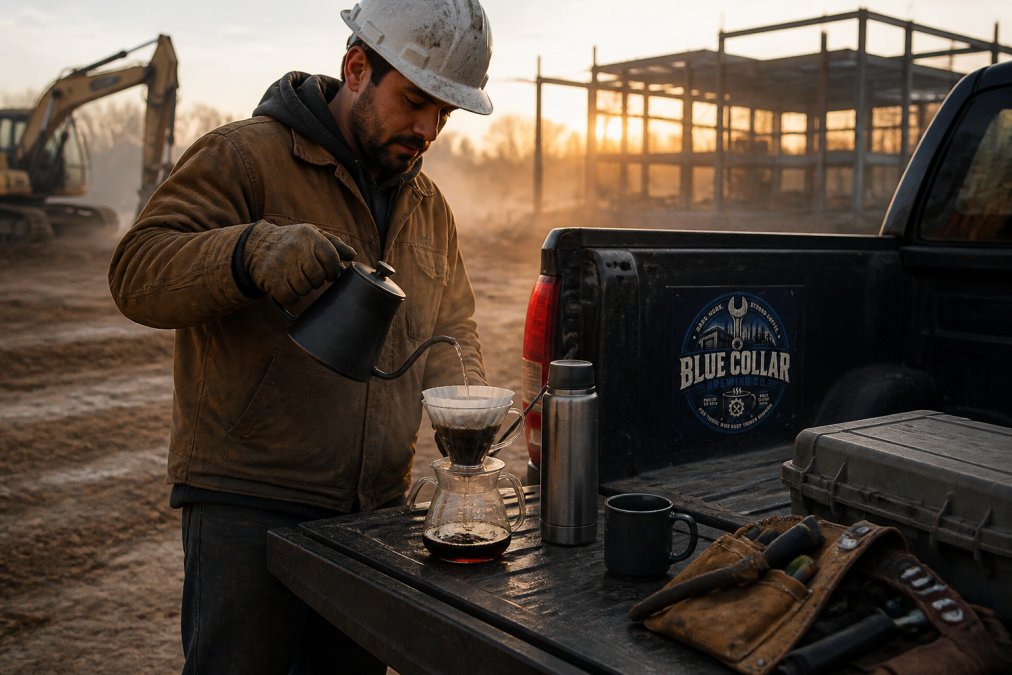
Step 1: Heat Your Water
Target 195-205°F (How Hot is Hot Enough? Brew Temperature, Sensory Profile, and Consumer Acceptance of...). Water boils at 212°F, so pull it off the heat and let it sit 30-45 seconds before you pour. Without a thermometer, pour boiling water into a second vessel (your thermos works) and back into the kettle, that transfer drops it into range without guessing. This matters most for pour-over and AeroPress; French press is forgiving, and a drip machine handles temperature itself, which is why cheap ones run too cool and produce flat coffee.
Step 2: Measure and Add Coffee
Use a 1:16 coffee-to-water ratio by weight as your starting point: 20 grams of coffee to 320 grams of water for a standard 10-ounce mug (Standards).
Grind size depends on your method:
- Pour-over: medium-fine, like table salt
- AeroPress: fine, closer to espresso
- French press: coarse, like sea salt
- Drip machine: medium, matching the machine's basket filter
Add the grounds, then pour a small amount of water just to wet them and wait 30 seconds. This bloom lets trapped carbon dioxide escape so water can extract flavor.
Step 3: Brew and Serve
Pour-over takes about 3 minutes total, including the bloom; pour in slow circles, keeping the bed level. French press steeps 4 minutes, then press and pour immediately, because leaving coffee on the grounds keeps extracting and turns bitter. AeroPress is fastest at roughly 90 seconds.
Brew time is where most people go wrong. Under-extracted coffee tastes sour and thin; over-extracted tastes bitter and harsh. If your cup is sour, grind finer or brew longer; if bitter, do the opposite.
Portable Coffee Makers for Job Sites: Which One Fits Your Setup
The right brewer matches three site conditions: how many people you're brewing for, whether you have reliable power, and how much attention you can spare while working. Get those wrong and even a great brewer becomes a hassle you stop using.
Here's how the common options behave in the field:
| Method | Brew Time | Power Needed | Durability | Best For |
|---|---|---|---|---|
| French press | 4 min | None | High | Crews, cold weather |
| AeroPress | 90 sec | None | High | Solo workers, quick breaks |
| Pour-over | 3 min | None | Medium | One careful cup |
| Drip machine | 8-10 min | Yes | Low | Break rooms, shops |
| Moka pot | 5 min | Heat source | High | Strong coffee, stovetop |
French Press: The Crew Standard
A 34-ounce stainless French press makes roughly four 8-ounce cups in one steep, which is why it wins for crews. The metal mesh filter means no paper supply to run out of, and full immersion is forgiving of small temperature swings. The trade-off is cleanup and fines that slip through the mesh; a two-stage press with a secondary filter cuts the sludge.
AeroPress: The Solo Performer
The AeroPress brews one concentrated cup in about 90 seconds and packs down to roughly the size of a large water bottle. It's the best pick if you work alone and want a clean cup fast, but one press makes about 8 ounces, a poor fit for a five-person crew unless you run it in shifts.
Pour-Over: The Attention Tax
A cone and filter is the lightest setup you can carry, but it demands a steady pour and a level bed. On a windy roof or vibrating tailgate, that's harder than it sounds, so it's best for a single careful cup.
Drip Machine: The Break-Room Compromise
A drip machine is the easiest way to make coffee for a room full of people, but it needs power and doesn't travel. The bigger issue is temperature: many inexpensive machines brew below 195-205°F, which is why break-room coffee so often tastes flat. For a shop, look for a model that states its brew temperature.
Moka Pot: Strong and Stovetop-Ready
A moka pot runs on any heat source, including a camp stove, and produces a concentrated, espresso-adjacent cup in about five minutes. It's durable and cheap to run, but fussy about grind (too fine and it clogs, too coarse and it's weak) and hot enough to burn you if you're careless.
Match the brewer to the job, not the other way around. A solo electrician on a service call and a six-person framing crew have almost nothing in common when it comes to coffee gear. Buy for the setup you actually work in.
How to Keep Coffee Hot on the Job
A vacuum-sealed thermos keeps coffee hot for 6-12 hours, depending on quality and how often you open it. The trick isn't the thermos, it's the prep.
Preheat the thermos by filling it with boiling water for 5 minutes, then dump that water and add your coffee. A cold thermos steals heat from the first cup and everything after it. Fill the thermos to the top, because air space is where heat escapes fastest. And don't open it just to check. Every time you unscrew the lid, you lose heat you can't get back.
For crews running all day, a 64-ounce thermos with a pour spout beats individual mugs. One person fills it in the morning, everyone pours as needed, and the coffee stays hot through the afternoon shift.
High Caffeine Coffee for Night Shifts
Night-shift coffee needs more caffeine per cup and less sugar crash. The answer isn't a bigger mug, it's a darker roast, a tighter ratio, and water that actually extracts the grounds.
Why Dark Roast Feels Stronger (Even When It Isn't)
Dark roasts don't have more caffeine by weight than light roasts, caffeine is fairly stable through roasting.
Match the Brew to the Roast Profile
Water Chemistry: The Variable Nobody Mentions
Cold Brew: The Practical Night-Shift Option
Brew a batch of cold brew concentrate on your day off and keep it in the fridge. A 1:8 concentrate diluted 1:1 with water or milk gives you a fast, consistent night-shift cup with zero brewing on site.
Common Mistakes to Avoid When You Brew Coffee on Site
Other mistakes worth fixing:
The single biggest upgrade to on-site coffee isn't a better brewer, it's a scale and fresh-ground beans. Those two changes fix more problems than any equipment swap.
How to Keep Coffee Hot on the Job
High Caffeine Coffee for Night Shifts
Common Mistakes to Avoid When You Brew Coffee on Site
Other mistakes worth fixing:
Frequently Asked Questions
How do you make coffee on a job site without electricity?
You need three things: a heat source, a brewing device, and ground coffee. A portable propane burner or a thermos of pre-heated water handles the heat. For brewing, a French press or pour-over cone works without power. Measure roughly 2 tablespoons of grounds per 6 ounces of water, let it steep 4 minutes in a press or pour slowly through a filter, and you have a full cup in under 6 minutes. No outlet required.
What is the best portable coffee maker for construction sites?
A French press or an AeroPress handles job site conditions best. Both are durable, need no electricity, and clean up with a quick rinse. A French press brews 2-4 cups at once, which suits a crew. The AeroPress is lighter and faster for one person. If you want zero cleanup, single-serve capsules in a small manual press work too. Pick based on how many people you're brewing for and how much space you have in your truck or bag.
How do you keep coffee hot while working outdoors?
Pre-heat your thermos with boiling water for 2 minutes, dump it, then fill with fresh coffee. A quality stainless steel vacuum thermos holds heat 6-12 hours. Keep it sealed between pours and out of direct wind. For all-day shifts, bring two smaller thermoses instead of one large one; you open each less often, so the coffee inside stays hotter longer. Avoid glass-lined containers on site; they crack.
What are the best high caffeine coffee options for night shifts?
Dark roasts and robusta-heavy blends can offer a robust flavor that feels stronger. A dark roast like a cowboy blend has a heavier body that holds up well in a thermos. Pair it with a slightly stronger ratio (2.5 tablespoons per 6 ounces) and drink it in smaller amounts across the shift instead of one large cup at the start.