

Pine and Steel Coffee Alternatives: Best Caffeine-Free Picks
Table of Contents
- Why Switch From Pine and Steel Coffee?
- Top Coffee Alternatives Compared: Quick Look
- 1. Mushroom Coffee: Focus and Stamina in a Cup
- 2. Roasted Teas: Hojicha and Matcha
- 3. Herbal Infusions: Rooibos and Chai
- Is Premium Coffee Worth the Price?
- How to Brew Coffee Alternatives at Home
- What to Watch For: Sourcing and Side Effects
- Frequently Asked Questions
Last Updated: September 8, 2026
Why Switch From Pine and Steel Coffee?
Searching for "Pine and Steel coffee alternatives" usually means one thing: you love the ritual of coffee, but the caffeine is starting to work against you. Whether you are dealing with afternoon jitters, disrupted sleep, or a growing caffeine sensitivity, the answer isn't quitting your morning ritual. It is finding a brew that delivers the warmth, depth, and routine without the energy crash.
Coffee alternatives are beverages that mimic the flavor, mouthfeel, and ritual of coffee using roasted roots, grains, herbs, or teas. The best options deliver a jitter-free energy lift or a deeply satisfying cup that stands on its own. Swapping one cup a day can change your whole shift.
Below, we break down the top caffeine-free picks, how to brew them at home, and what to watch for with sourcing and side effects.
Top Coffee Alternatives Compared: Quick Look
Not every alternative suits every worker. A roofer starting at dawn needs something different from a warehouse manager winding down after a double shift. Here is a quick snapshot of the main options we cover.
| Option | Caffeine Level | Flavor Profile | Best For | Price |
|---|---|---|---|---|
| Mushroom Coffee | Low (from coffee base) | Earthy, dark, smooth | Focus and stamina | $19.99 |
| Hojicha | Low | Toasted cereal, umami | Smooth, low-acid cup | $18.99 |
| Matcha | Moderate | Vegetal, grassy, sweet | Steady energy lift | $18.99 |
| Rooibos | Zero | Sweet, spicy, woody | Caffeine-free comfort | $14.99 |
| Masala Chai | Low (from black tea) | Bold, spicy, aromatic | Intense flavor | $14.99 |
The key difference comes down to what you are replacing. If you want the dark, roasted character of your usual cup, mushroom coffee or hojicha comes closest. If you are chasing a ritual that feels like a treat, chai or rooibos delivers.
1. Mushroom Coffee: Focus and Stamina in a Cup
Mushroom coffee is the closest swap for someone who refuses to give up the dark, rich taste of a proper brew. It blends specialty-grade coffee with functional mushrooms like Lion's Mane, Cordyceps, and Reishi, valued in traditional practices for supporting clarity, stamina, and balance.

Blue Collar Brewing offers this in a Coffee with Mushrooms Dark Roast and a Medium Roast, both at $19.99. The dark roast suits anyone who wants a bold, low-acidity cup, while the medium roast keeps more of the bean's natural brightness. For crews on the move, the Instant Coffee with Mushroom pouch provides about 30 servings.


A common mistake is expecting these to taste like a health supplement. They do not. The mushroom powder blends into the coffee so the cup still tastes like coffee, with a slightly earthier finish.
2. Roasted Teas: Hojicha and Matcha
For those who want to move away from coffee entirely but still crave a ceremonial brew, roasted teas are the bridge. Hojicha is a roasted green tea powder that brews into a smooth, comforting cup with notes of toasted cereal and balanced umami. Because the leaves are roasted over charcoal, the caffeine level drops significantly, making it a smart afternoon pick.
Matcha, by contrast, delivers a steadier energy lift. The powdered green tea releases caffeine slowly alongside L-theanine, an amino acid that promotes calm focus without the spike-and-crash pattern many coffee drinkers know too well.
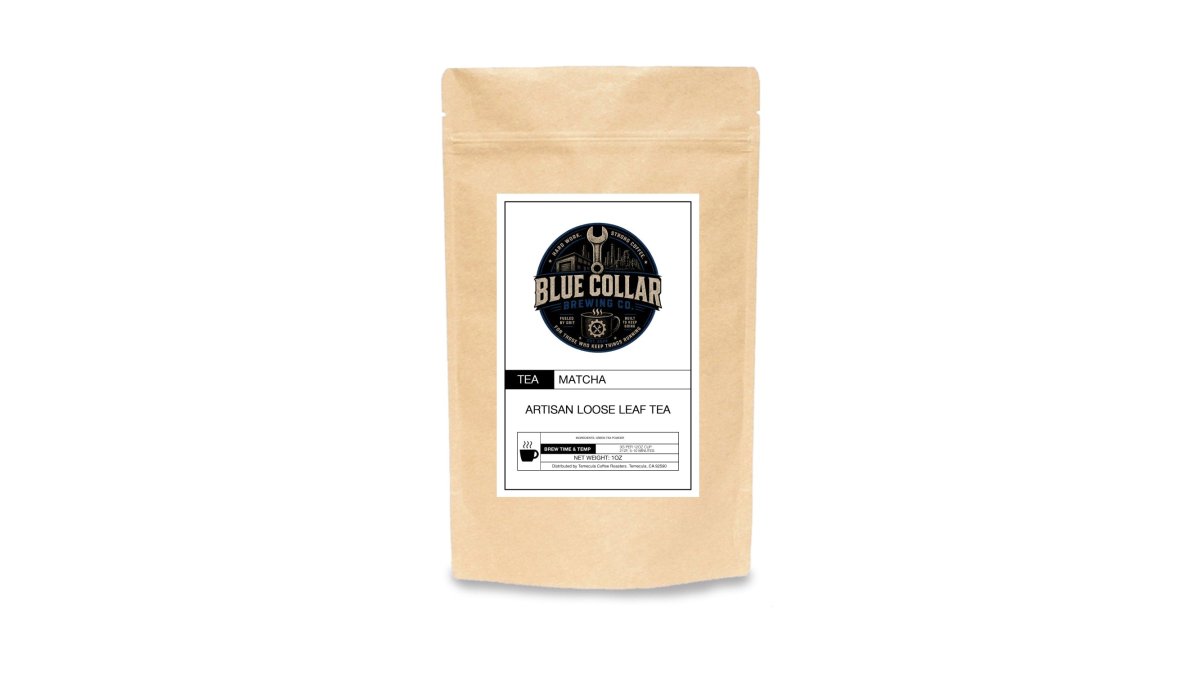
Blue Collar Brewing carries both as stone-milled powders at $18.99 each. The Hojicha works beautifully as a lower-caffeine alternative, while the Matcha suits the first cup of the day when you still need to get moving.
3. Herbal Infusions: Rooibos and Chai
Herbal infusions are the only true zero-caffeine options on this list. Rooibos, a South African red bush tea, is naturally caffeine-free and known for its smooth, sweet character. Blue Collar Brewing's Apple Cider Rooibos adds cinnamon, orange peel, and natural spices for a cup that tastes like fall but works year round.
Masala Chai takes the opposite approach. It is bold, spicy, and intense, built on a black tea base that still carries caffeine. The Masala Chai from Blue Collar Brewing is full-bodied and aromatic, and it shines when served with milk and a little sugar, the traditional way. Both options sit at $14.99, making them the most budget-friendly way to build a daily caffeine-free ritual.
For anyone dealing with caffeine withdrawal headaches, going straight from multiple coffees to zero caffeine is rough. Rooibos gives you the comforting warmth and sweetness of a coffee-adjacent drink while your body adjusts.
Is Premium Coffee Worth the Price?
This is the question every worker asks before switching. The honest answer is that price only matters if the flavor and freshness justify it. The cost-per-cup analysis is where the decision gets made.
A bag of commodity coffee can sit on a shelf for months before it reaches your cup. Coffee roasted to order arrives at your door days after roasting, when the volatile compounds that create aroma and flavor are still intact. Blue Collar Brewing roasts every batch to order, meaning the coffee you receive is measurably fresher than anything sitting in a warehouse.
Here is the breakdown that most guides skip. Assume a daily habit of two cups. A 12-ounce bag of premium, freshly roasted coffee yields roughly 20 to 24 cups, depending on your brew ratio. At $19.99 per bag, that lands between $0.83 and $1.00 per cup. The daily difference compared to commodity coffee can be about $0.50 to $1.00.
Now compare that to the alternative: a daily gas station or fast-food coffee runs $2.50 to $4.00 per cup. If you were buying two of those a day, you are spending $5.00 to $8.00 daily. Switching to a premium home-brewed cup saves you roughly $4.00 to $7.00 per day, or $120 to $210 per month. The premium bag is not the expensive option. The convenience store is.
The same logic applies to tea. A 100-gram tin of ceremonial matcha at $18.99 provides roughly 30 servings when whisked properly at 2 grams per bowl. That is $0.63 per serving. The gap in price per serving buys you a fundamentally different product: stone-milled, shade-grown, and fresh.
When you factor in the cost of not switching, the math gets even clearer. Caffeine crashes lead to lost productivity and the urge to buy another overpriced drink mid-afternoon. A $4.00 energy drink or a second coffee is a hidden tax on your day. A properly brewed hojicha or rooibos at home eliminates that second purchase entirely.
The real question is not whether premium is worth it. It is whether you are currently paying the convenience premium without realizing it. Freshly roasted coffee and freshly milled tea are not luxury items. They are the most cost-effective way to build a daily ritual that actually tastes good enough to stick with.
How to Brew Coffee Alternatives at Home
The brewing method changes the outcome more than most people expect. Getting the water temperature and steeping time right is the difference between a smooth, sweet cup and a bitter, over-extracted one.
For mushroom coffee, treat it like regular coffee. Use water just off the boil, around 200 degrees Fahrenheit, and let it steep for four minutes if using a French press. The instant version is simpler: one scoop, hot water, stir.
For matcha and hojicha powders, temperature matters even more. Boiling water scorches green tea and turns it bitter. Use water around 175 degrees Fahrenheit. Whisk vigorously in a zigzag motion until a light foam forms on top. This takes about 30 seconds and is the step most beginners skip.
For loose-leaf rooibos and chai, steeping time is your main lever. Rooibos needs five to seven minutes to fully release its sweetness. Chai can handle a rolling boil with milk for a few minutes to extract the spice oils.
| Beverage | Water Temp | Steep Time | Key Step |
|---|---|---|---|
| Mushroom Coffee | 200°F | 4 minutes | Use fresh grounds |
| Matcha / Hojicha | 175°F | Whisk 30 sec | Never use boiling water |
| Rooibos | 212°F | 5-7 minutes | Patience releases sweetness |
| Masala Chai | Boil with milk | 3-5 minutes | Simmer to extract spices |
What to Watch For: Sourcing and Side Effects
Two factors rarely get discussed in coffee alternative guides: where the ingredients come from and how they interact with your body. Both determine whether your new ritual is genuinely better for you and the planet.
The Environmental Angle Most Guides Ignore
Coffee is a globally traded commodity, and the average bag of beans travels thousands of miles before it reaches your grinder. The carbon footprint of that journey is real, though it is often overshadowed by the larger impact of farming practices. When you switch to locally or regionally sourced herbal alternatives, you are not just changing your caffeine intake; you are shortening the supply chain.
Rooibos is the exception here, as it is grown exclusively in South Africa's Western Cape region. That is a long journey regardless of where you buy it. But many roasted grain beverages, chicory, dandelion root, and even some herbal blends can be sourced from farms within the United States. The USDA organic certification standards provide a baseline for verifying that what is in the bag matches what is on the label, but they do not tell you about transportation emissions. Look for brands that disclose their sourcing regions or that prioritize domestic farms where possible. A locally roasted dandelion root beverage has a fraction of the transport footprint of a coffee bean shipped from a high-altitude farm in another hemisphere.
Contraindications and Side Effects: The Details That Matter
This is where most listicles drop the ball. They tell you to try chicory or dandelion root without mentioning that these are not inert substances. They have real physiological effects.
Chicory root is the most common coffee alternative, and it is also the one with the most documented interactions (peer-reviewed research). It contains inulin, a type of soluble fiber that feeds gut bacteria. For most people, that is a benefit. For someone with irritable bowel syndrome or a sensitivity to FODMAPs, a large cup of chicory "coffee" can trigger bloating, gas, and abdominal cramping within hours. The effect is dose-dependent. A small cup might be fine. A 16-ounce mug on an empty stomach is a gamble. If you have a history of gallstones, talk to your doctor first, as chicory stimulates bile production.
Dandelion root is a mild diuretic and stimulates bile flow from the liver. For most people, this is harmless or even beneficial. But if you are on lithium, a diuretic effect can alter how your body clears the medication, potentially raising blood levels. If you take diuretics or blood thinners, dandelion root deserves a conversation with your doctor before you make it a daily habit.
Mushroom coffee is generally well tolerated, but the functional mushrooms in it are not culinary mushrooms. Reishi, in particular, can interact with blood pressure medication and has anticoagulant properties. Lion's Mane is being studied for nerve growth factor stimulation, but the long-term implications of daily consumption are not fully mapped. If you take prescription meds for blood pressure, blood sugar, or blood clotting, check with your doctor before making mushroom coffee a daily staple.
Chai and hojicha still contain caffeine, just less than coffee. A cup of hojicha has roughly 10 to 20 milligrams of caffeine compared to 95 milligrams in a standard cup of coffee (PubMed). Masala chai made with black tea runs 40 to 60 milligrams depending on steep time. If you are cutting caffeine for medical reasons, rooibos is the only fully caffeine-free option on this list.
Sourcing and side effects are not the glamorous part of switching your morning cup. But they are the difference between a habit that serves you and one that quietly works against you. Read labels. Ask questions. Your body and your budget will thank you.
Frequently Asked Questions
What is the best coffee alternative that still tastes like coffee?
Roasted grain and root beverages, like those made from chicory or dandelion, come closest to mimicking coffee's bitter, roasted flavor profile. For a smoother option that keeps some richness, mushroom coffee blends like Blue Collar Brewing's Coffee with Mushrooms use specialty-grade coffee beans, so you get the familiar taste with added adaptogens. If you want zero caffeine, a roasted barley or chicory-based brew offers the most coffee-like mouthfeel and bitterness without the jitters.
Can coffee alternatives provide the same focus as caffeinated coffee?
They provide a different kind of focus. Coffee gives a rapid energy lift followed by a crash. Alternatives like matcha contain L-theanine, which promotes calm, sustained alertness without the jittery side effects. Mushroom coffee blends with Lion's Mane are traditionally used to support clarity and focus. These options are a solid choice if you're sensitive to caffeine or want to avoid the afternoon slump.
How do herbal coffee substitutes compare to traditional roasts?
Herbal substitutes like rooibos or chicory lack the heavy body and dark bitterness of a traditional coffee roast. They offer lighter, often sweeter or spicier tasting notes. Rooibos has a naturally sweet, nutty flavor, while chicory root provides a roasted, slightly woody taste. They also brew differently, often requiring a longer steeping time rather than a quick espresso shot, and they contain no caffeine, so you won't get the same energy lift.
What is the safest coffee alternative for those with acid reflux?
Coffee's high acidity levels are a common trigger for acid reflux. Low-acid options include cold brew coffee and mushroom coffee blends, which tend to be gentler on the stomach. Herbal infusions like rooibos are naturally caffeine-free and low in acid, making them a safe choice. A dark roast is also less acidic than a light roast. If you're prone to heartburn, try a roasted dandelion or chicory-based drink, as they are naturally acid-free.
Is premium coffee worth the price for a daily cup?
For many, the difference comes down to cost-per-cup. A $19.99 bag of premium, fresh-roasted coffee from Blue Collar Brewing yields roughly 30 cups, or about 67 cents per cup. That's often cheaper than a gas station coffee and noticeably better in flavor and aroma. If you value flavor and a smooth, rich experience, the small price difference is worth it.