

Coffee Delivery for Construction Crews: 2026 Guide
Table of Contents
- Coffee Delivery for Construction Crews: What You'll Need
- Step 1: Calculate How Much Coffee Your Crew Drinks
- Step 2: Choose Bulk Coffee Catering for Job Sites
- Step 3: How to Keep Coffee Hot for Large Groups
- Step 4: Coordinate Site Access and Safety Protocols
- Step 5: Pick the Right Coffee for Manual Labor
- Common Mistakes with Coffee Delivery for Construction Crews
- Conclusion
- Frequently Asked Questions
Last Updated: September 10, 2026
Coffee Delivery for Construction Crews: What You'll Need
Coffee delivery for construction crews means getting fresh, hot coffee to a job site in quantities that match a crew's actual consumption, without burning time on supply runs. At Blue Collar Brewing, we roast every batch to order, ensuring maximum flavor, aroma, and character in every cup. This guide covers calculating demand, choosing a bulk coffee catering for job sites provider, keeping drinks hot, and handling site access safely.
The math is unforgiving: a twelve-person framing crew working a ten-hour shift can empty a commercial airpot before lunch. Get the quantity wrong and you're making a mid-morning supply run; get the logistics wrong and the coffee arrives lukewarm.
The crews that get this right treat coffee like any other material on the job: ordered in bulk, scheduled ahead, and delivered on time.
Step 1: Calculate How Much Coffee Your Crew Drinks
Start with a simple baseline: plan on two to three cups per worker per shift, with heavier consumption on early morning shifts and cold-weather days (the CDC). A twenty-person crew needs roughly forty to sixty cups, or three to four gallons.
Daily consumption by crew size
Use these planning figures, then adjust based on your crew's habits:
| Crew Size | Cups per Shift (2-3 each) | Brewed Volume | Grounds Needed |
|---|---|---|---|
| 5 workers | 10-15 cups | 1 gallon | About 1 lb |
| 12 workers | 24-36 cups | 2-3 gallons | About 2 lb |
| 25 workers | 50-75 cups | 4-5 gallons | About 4 lb |
| 50 workers | 100-150 cups | 8-10 gallons | About 8 lb |
Bulk packaging solutions for job sites
Whole bean and ground bulk bags scale better than single-serve formats on large sites, because you brew by the gallon rather than one cup at a time. Single-serve capsules make sense on smaller crews or in site trailers where counter space is tight. A common mistake is ordering only for the morning push and forgetting the afternoon slump; most crews want a second round after lunch.
Step 2: Choose Bulk Coffee Catering for Job Sites
Bulk coffee catering for job sites works best when the provider delivers on a fixed schedule rather than on demand. Ask three questions before you commit: How often do you deliver? Can you hit a 5 a.m. window? What happens when weather delays a pour?
Breakfast and lunch delivery logistics
Breakfast catering usually means coffee plus something portable: breakfast sandwiches, burritos, or pastries that survive a cooler. The provider needs a fixed drop point, a named contact on site, and a delivery window that matches your break schedule. If your crew eats at 6 a.m. and 11:30 a.m., the coffee has to land before both, not during.
Subscription vs. one-time orders
A subscription suits ongoing projects where crew size stays stable, because the order ships automatically. One-time orders fit short jobs, punch-list work, or a single pour for a concrete day. Many project managers run a subscription for the base volume and add one-time orders when the crew spikes.
Blue Collar Brewing roasts to order and ships on a simple schedule.
Step 3: How to Keep Coffee Hot for Large Groups
The single biggest failure point in coffee delivery for construction crews is heat loss between the roaster and the break trailer. Holding coffee above 140°F for a full shift requires the right equipment, not just a good thermos (the FDA). Coffee loses heat to the vessel, to the air every time the lid opens, and to the cold surface it sits on. Control all three and a five-gallon urn will still pour a hot cup at the second break.
Match the container to the crew size and site
| Format | Typical Capacity | Realistic Hold Time | Best For |
|---|---|---|---|
| Pump airpot | 2.5-3 liters | 2-3 hours | Small crews, trailer counters, self-serve lines |
| Thermal carafe | 1-2 liters | 2-4 hours | Satellite locations, foreman trucks, small pours |
| Insulated urn | 3-5 gallons | 4-6 hours if kept closed | Large sites, full-shift coverage |
| Individual sealed cups | 12-20 oz | 30-60 minutes | Punch-list work, single-trade crews, no brewing gear on site |
A five-gallon urn is the workhorse for a 25- to 50-person site because it covers the morning push and the after-lunch round without a refill. Airpots win on smaller crews because workers serve themselves. Individual sealed cups are the only format that works with no brewing equipment, water source, or counter space, common on punch-list and remodel jobs.
Preheat, fill to the top, and keep the lid closed
- Preheat everything: Rinse carafes and urns with hot water for 30-60 seconds before filling. A cold stainless urn steals heat from the first gallon and the coffee never fully recovers.
- Fill to the top: Air is the enemy. A half-full urn has a large headspace that radiates heat away. Top off with hot water if you are short.
- Keep the lid closed between pours: Every time you open a five-gallon urn, you dump a pocket of heat. On a 30°F morning, that is the difference between a hot second cup and a lukewarm one.
- Insulate the base: Setting an urn on a cold concrete slab or metal trailer floor pulls heat through the bottom. A folded moving blanket or foam pad under the urn buys another 30-45 minutes.
Packaging trade-offs for outdoor environments
Bulk packaging is not just about volume, it is about temperature stability in wind, cold, and dust. Sealed individual cups hold heat for a shorter window but require no cleanup or equipment, which matters when the break area is a tailgate. Thermal carafes and urns hold heat longer but need a flat surface and a responsible person to manage them. On sites with no trailer, the practical answer is often a mix: a sealed case of individual cups for the crew plus one preheated airpot for the foreman's truck.
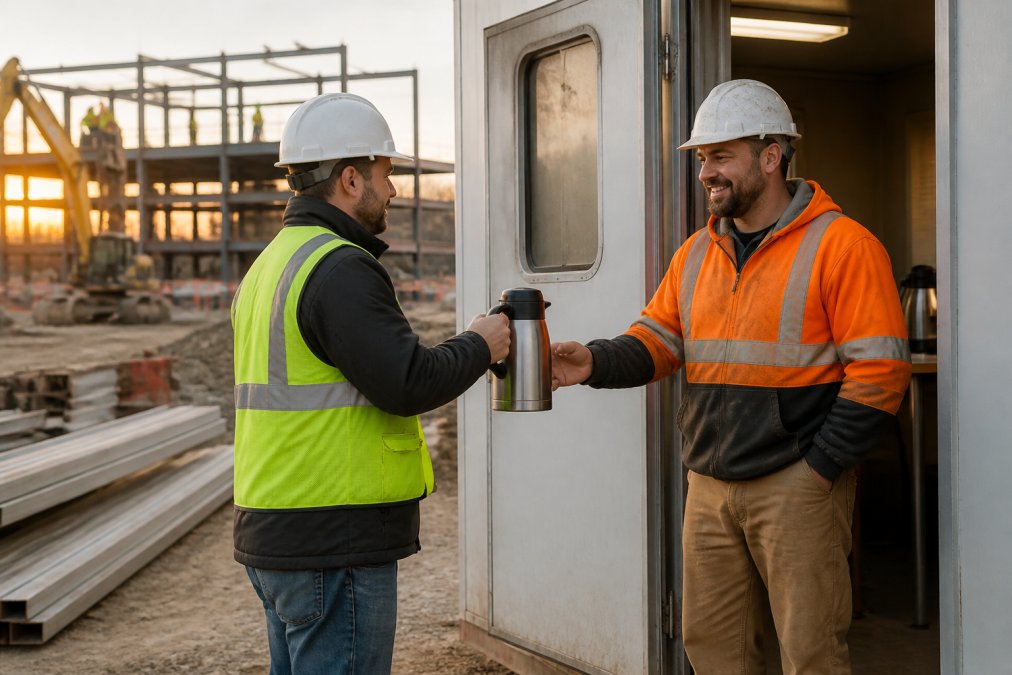
Step 4: Coordinate Site Access and Safety Protocols
Site access is where most coffee delivery plans fall apart. A driver without the right gear gets turned away at the gate, and the coffee goes cold in the truck. Coordinate access before the first delivery, not on the morning of.
PPE requirements for delivery drivers
Most active job sites require a hard hat, high-visibility vest, and steel-toe boots for anyone entering the work zone (osha.gov). Confirm the site's rules with the superintendent and pass them to your delivery provider. Some sites restrict vehicle access entirely, so the drop point is the gate or trailer, not the work area.
Ordering protocols for project managers
Put one person in charge of ordering. A single point of contact avoids duplicate orders and missed deliveries. Share the site address, gate location, drop point, delivery window, and a backup phone number. If the site has a check-in procedure or safety orientation, schedule the driver through it once and note it for future deliveries.
Step 5: Pick the Right Coffee for Manual Labor
Manual labor burns energy fast, and the coffee that works for a desk job is not always right on a job site. A framing crew on a 20°F morning burns more calories, loses more fluid to sweat and cold dry air, and wants a cup that stays warm in a travel mug. The goal is not just caffeine, it is caffeine plus hydration plus a food pairing that keeps the crew steady through the afternoon.
Caffeine, hydration, and the afternoon crash
Caffeine is a performance tool on a job site, but it is also a mild diuretic. Crews do best when coffee is paired with water, not used as a replacement for it. A simple rule: one 16-ounce water bottle per cup of coffee, especially on hot days or in heavy PPE. Black coffee delivers caffeine without the sugar crash that follows energy drinks, and a smoother roast makes the switch easier for workers cutting back on sugary drinks.
For crews doing heavy work in cold conditions, a stronger, darker cup holds up to a splash of creamer and a travel mug. For crews that want more caffeine without a bigger cup, a high-caffeine blend does the job. Blue Collar Brewing's Max Caf Blend pairs Tanzanian and Indian Robusta for a stronger cup, while the Breakfast Blend + adds Robusta to a medium roast for extra kick without the bitterness. For site trailers with limited space, the 60 Pack Single Serve Coffee Capsules keep things simple: sealed, fresh, and no brewing equipment beyond a machine.


Pair coffee with high-protein, high-energy food
Coffee alone will not carry a crew through a ten-hour shift. The nutritional gap on most job sites is protein and slow-burning carbohydrates, not caffeine. When you order coffee delivery, add food that holds up in a cooler and can be eaten one-handed:
- Breakfast: Egg and cheese sandwiches, breakfast burritos, or Greek yogurt cups with granola. Aim for 15-25 grams of protein per worker to blunt the mid-morning crash.
- Lunch: Deli sandwiches, wrap platters, or chili in insulated containers. Pair with fruit or a granola bar for quick carbohydrate between tasks.
- Afternoon: Jerky, nuts, or protein bars kept in the trailer. These bridge the gap between lunch and the end of shift without a sugar spike.
A common pattern on large sites is a coffee-only morning delivery and a coffee-plus-food lunch delivery, matching how crews eat: fast and light at 6 a.m., heavier at midday.
Match the roast to the season and the task
- Cold-weather, outdoor work: Darker roasts and higher-caffeine blends. The stronger flavor cuts through a cold palate and the extra caffeine helps with early starts.
- Hot-weather, high-sweat work: Medium roasts and lighter caffeine loads, paired with more water. Over-caffeinating a crew that is already dehydrated is a safety issue, not just a comfort one.
- Interior finish work and punch lists: Single-serve capsules or a medium roast in an airpot. Lower volume, less waste, no brewing gear needed.
Common Mistakes with Coffee Delivery for Construction Crews
The most common mistakes are predictable, and every one costs time or money. Ordering too little is the classic error; crews drink more than managers expect, especially on cold mornings. Ordering too late is the second: a delivery that lands after the first break is wasted.
Other frequent problems:
- No single point of contact. When three people order, you get three deliveries and three invoices.
- Ignoring site access rules. A driver without PPE doesn't get past the gate.
- Skipping the preheat. Cold urns and carafes kill the first gallon's temperature.
- Choosing the wrong format. Single-serve capsules on a fifty-person site create a bottleneck at the machine.
- Forgetting the afternoon. Plan for a second round, not just the morning push.
Avoid these and the process runs itself. Miss them and you're back to gas station coffee by week two.
Conclusion
Getting coffee to a job site reliably comes down to planning quantity, choosing a provider that delivers on schedule, and coordinating access before the first drop. Blue Collar Brewing roasts every batch to order, offers bulk formats that scale from a five-person crew to a full site, and ships on a simple, reliable schedule. Shop Coffee with Blue Collar Brewing and give your crew fresh-roasted fuel that shows up hot, on time, and in the right quantity.
Frequently Asked Questions
How much coffee should I order for a construction crew of 20 people?
Plan for 2 to 3 cups per person per shift, which means about 40 to 60 cups total. A standard 12-cup commercial brewer makes roughly 60 ounces, so you would need 4 to 5 full batches. For a 20-person crew, a 60-pack of single-serve capsules or a bulk bag of whole bean coffee works well. If your crew works overtime or double shifts, increase that estimate by 50 percent.
What is the best way to coordinate coffee delivery for a large job site?
Designate one person, usually the project manager or foreman, to place orders and confirm the delivery window. Provide the exact site address, gate access instructions, and a contact number for the driver. Schedule delivery before the morning shift starts or during a scheduled break to avoid disrupting work. For recurring orders, set up a weekly or biweekly subscription so coffee arrives on the same day each week without someone having to remember to reorder.
How do you keep coffee hot when delivering to remote construction sites?
Use insulated thermal carafes or airpots that hold heat for 4 to 6 hours. Pre-heat the carafe with hot water before filling it with coffee. For larger groups, transport coffee in 5-gallon insulated beverage dispensers. Wrap dispensers in moving blankets during cold-weather months. If the site is more than 30 minutes away, seal the carafes immediately after filling and avoid opening them until you arrive.
Are there specific coffee catering services that specialize in construction sites?
Some coffee companies focus on bulk delivery for job sites and industrial settings. Look for services that offer bulk coffee catering for job sites, flexible delivery windows, and packaging designed for groups. Blue Collar Brewing roasts to order and ships directly, which works well for crews that want fresh coffee without a local roaster nearby. Ask about minimum order sizes, delivery frequency, and whether they can accommodate early morning drop-offs before your shift begins.