

Fresh Roasted Coffee vs Grocery Store: Real Difference
Table of Contents
- Fresh Roasted Coffee vs Grocery Store: The Core Difference
- What a Roast Date Actually Tells You (vs Expiration Date)
- How to Tell if Coffee Is Fresh Before You Brew
- Flavor and Aroma: What Changes as Coffee Ages
- Price Per Cup: Fresh Roasted Coffee vs Grocery Store
- How to Store Coffee Beans at Home
- Which One Should You Buy?
- Conclusion: Make the Switch That Matters
- Frequently Asked Questions
Last Updated: September 4, 2026
Fresh Roasted Coffee vs Grocery Store: The Core Difference
The difference between fresh roasted coffee vs grocery store coffee comes down to one thing: time. Most supermarket bags sit on shelves for weeks or months after roasting, slowly losing the volatile compounds that give coffee its aroma and flavor. Fresh roasted coffee reaches your cup within days of leaving the roaster. At Blue Collar Brewing, we roast every batch to order, so the beans you brew still carry the oils and gases that create a rich, full-bodied cup.
Fresh roasted coffee is coffee roasted recently enough to retain its peak flavor and aroma. Roasted beans release carbon dioxide for days after roasting and absorb oxygen, causing oxidation and flavor decay. Grocery store coffee is often roasted months before it reaches the shelf, then ground and packed in bulk.
What a Roast Date Actually Tells You (vs Expiration Date)
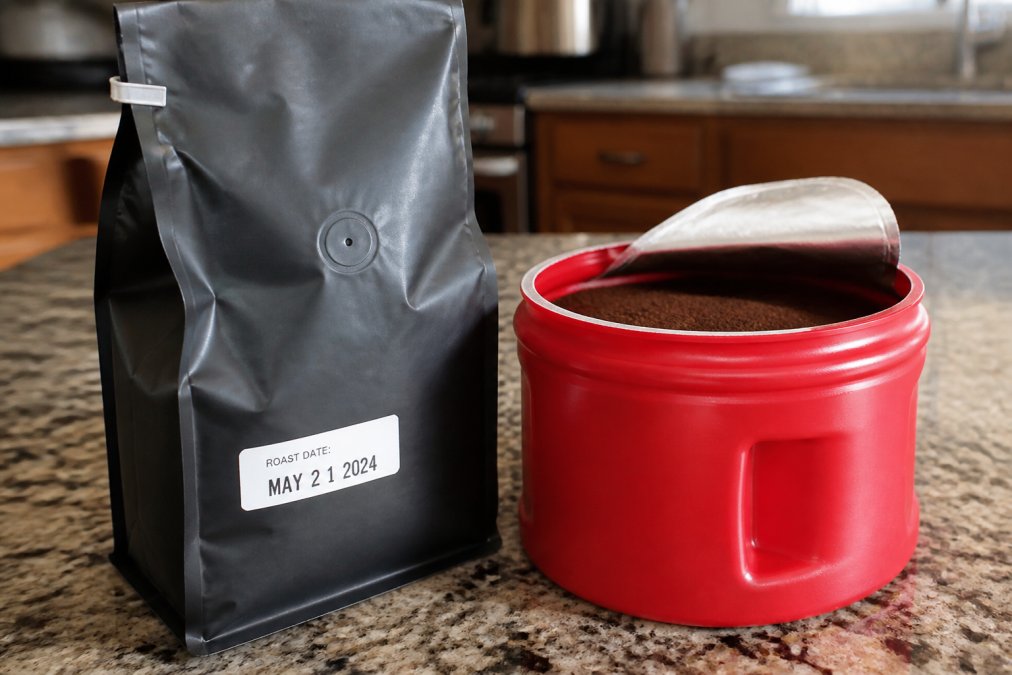
A roast date is the single most reliable indicator of coffee freshness. It tells you exactly when the beans were roasted, letting you calculate how many days have passed. An expiration date is a legal or commercial placeholder that reflects shelf stability rather than peak flavor. Many grocery store coffees carry expiration dates a year or more out, telling you almost nothing about how the coffee will taste today.
Specialty roasters print roast dates because they want you to know the coffee is fresh. Supermarkets rarely do, because their supply chain depends on long shelf life. Look for coffee roasted within the last two to four weeks. Coffee reaches peak flavor between three and fourteen days after roasting, during the degassing phase. After about a month, aromatic compounds fade noticeably, and by two months, much of the complexity is gone.
The Degassing Phase: Why Fresher Isn't Always Better
Here's where most guides get it wrong: coffee roasted yesterday is not ready to brew. Immediately after roasting, beans undergo a rapid release of carbon dioxide, up to 40% of the bean's weight in gas can escape in the first 24 hours.
If you brew coffee only 1 to 2 days off the roast, excessive CO2 interferes with extraction, creating a barrier between water and grounds and leading to under-extraction. The result is a cup that tastes sour, thin, and oddly carbonated, not the vibrant profile the roaster intended.
Most specialty roasters agree the sweet spot begins around day 3 and extends through day 14, when volatile aromatic compounds are at their peak and CO2 has subsided enough for even extraction. By day 21, delicate floral and fruity notes start to flatten. By day 30, you are drinking a shadow of what the bean offered.
This timeline is why the roast date matters more than any other label on the bag. A coffee roasted 5 days ago and one roasted 25 days ago may sit on the same shelf, but they will brew into entirely different cups.
Expiration Dates: A Legal Formality, Not a Flavor Guide
The FDA does not require expiration dates on roasted coffee. When a manufacturer prints one, it is typically a "best by" date tied to food safety and shelf stability, not flavor quality.
That date tells you almost nothing about whether the coffee will taste good. A bag with an expiration date 14 months away could have been roasted 6 months ago. The only way to know is to look for a roast date, and if it is absent, assume the coffee is old.
How to Read a Grocery Store Label Like a Pro
When you are standing in the coffee aisle, here is what to look for:
- Roast date printed on the bag: This is your green light. Look for a date within the last 14 days for peak flavor, or up to 21 days for acceptable quality.
- "Best by" date only: Assume the coffee is 3 to 6 months old. The flavor will be flat, and no amount of brewing skill will revive it.
- No date at all: This is the most common scenario for mass-market brands. The coffee was likely roasted 6 to 12 months ago and has been sitting in a warehouse or on a truck for most of that time.
- One-way valve on the bag: This small plastic valve lets CO2 escape without letting oxygen in. Its presence suggests the roaster understands freshness. Its absence on a grocery store bag is a red flag that the coffee was packed for long shelf life, not peak flavor.
FDA food labeling guidance confirms that expiration dates on coffee are manufacturer-set and not regulated for flavor quality. The roast date is the only number on the bag that tells you how the coffee will actually taste.
How to Tell if Coffee Is Fresh Before You Brew
You can evaluate coffee freshness without any special equipment. The bloom is your first test: pour hot water over fresh grounds and they release trapped carbon dioxide and swell. Coffee that blooms vigorously is fresh; coffee that barely bubbles has been sitting too long.
If buying whole beans, squeeze the bag and listen, fresh beans have a crisp crackle, older beans sound dull and muffled. Pre-ground coffee goes stale faster than whole beans because grinding exposes more surface area to oxygen, so buy whole beans and grind right before brewing.
| Freshness Test | What Fresh Looks Like | What Stale Looks Like |
|---|---|---|
| Bloom | Vigorous bubbling and swelling | Little to no reaction |
| Aroma | Sweet, complex, inviting | Flat, papery, dull |
| Bean sound | Crisp crackle when shaken | Muffled, lifeless |
| Grind | Whole beans, ground at home | Pre-ground, exposed to air |
Brewing Method Sensitivity: Freshness Is Not One-Size-Fits-All
Here is what most freshness guides skip: the same coffee can taste acceptable in one brewing method and undrinkable in another, depending on how old it is.
Espresso is the most demanding. High pressure forces water through finely ground coffee in 25 to 30 seconds, making extraction aggressive and complete. Stale beans, anything past 3 weeks, produce a thin, hollow, excessively bitter shot because the delicate acids have oxidized. Fresh beans (day 4 to day 10) are essential for a rich crema and balanced shot.
Pour-over is moderately forgiving. Methods like the V60 or Chemex rely on a steady, controlled pour over 2 to 4 minutes, giving you room to compensate for slightly older beans by adjusting grind size or water temperature. A coffee at day 18 can still produce a pleasant cup if you grind slightly finer and use water just off the boil.
Cold brew is the most forgiving, and the most misunderstood. Because cold brew uses time (12 to 24 hours) instead of heat to extract, it pulls fewer volatile aromatic compounds from the bean. A coffee 4 to 6 weeks old can still make a decent cold brew concentrate, especially if you prefer a chocolatey, low-acid profile, though you will lose the bright, complex notes of a fresh single-origin bean.
A DIY Blind Taste Test: Settle the Debate for Yourself
The most persuasive argument for fresh roasted coffee is not a blog post, it is your own palate. Here is a simple, repeatable method to compare fresh roasted coffee against grocery store coffee without bias.
What you need:
- One bag of fresh roasted whole beans (roast date within 10 days)
- One bag of grocery store whole beans (no roast date, or a "best by" date more than 6 months out)
- A burr grinder (or a consistent grind setting at a store)
- Two identical brewing devices (pour-over cones, French presses, or drip machines)
- Two identical mugs
- A friend or family member to help you set up the test blind
The method:
- Grind both coffees to the same consistency. Use the same dose and water temperature for both.
- Have your helper brew both cups in separate kitchens or at separate times, so you do not see which bag is which.
- Label the mugs "A" and "B" with no other identifying marks.
- Taste cup A first. Take note of three things: aroma, acidity (brightness), and finish (aftertaste). Write down one word for each.
- Rinse your palate with plain water. Wait 2 minutes.
- Taste cup B and do the same.
- Repeat the tasting in reverse order to confirm your impressions.
- Reveal which cup was which.
What to look for:
- Aroma: Fresh coffee will smell sweet and complex; stale coffee will smell flat or slightly musty.
- Acidity: Fresh coffee has a lively, wine-like brightness. Stale coffee tastes dull or sour in a harsh way.
- Finish: Fresh coffee leaves a clean, lingering sweetness. Stale coffee leaves a bitter, dry, or papery aftertaste.
This method also works for comparing two fresh roasters or testing whether a specific grocery store brand is fresher than you assumed. The point is to remove brand loyalty and marketing from the equation.
Flavor and Aroma: What Changes as Coffee Ages
The flavor difference between fresh roasted coffee and grocery store coffee is not subtle. Fresh coffee delivers a full spectrum of flavor notes: bright acidity, sweetness, body, and complexity. As coffee ages, oxidation breaks down the oils and volatile compounds that carry these flavors. The acidity fades first, then the sweetness, leaving a flat, bitter, or woody taste.
Coffee's shelf life is measured in weeks, not months. Single-origin beans and lighter roasts show their age faster because their delicate flavor notes are more pronounced. Darker roasts mask staleness better because the roast itself creates bold, smoky flavors, one reason mass-produced supermarket coffee leans dark.
Price Per Cup: Fresh Roasted Coffee vs Grocery Store
The price gap between fresh roasted coffee and grocery store coffee is smaller than most people assume. A typical 12-ounce bag of specialty coffee costs around $20, while a comparable can of supermarket coffee runs $8 to $12. A 12-ounce bag yields roughly 25 to 30 cups, so at $20 per bag you're paying about 70 cents per cup; at $10 per bag, about 35 cents.
And if you add cream and sugar to mask bitterness, part of that savings goes right back into your cup. For anyone drinking two or three cups a day, the monthly difference lands in the range of a single fast-food meal, a trade most drinkers find worth making for a noticeably better cup every morning.
National Coffee Association brewing guidelines suggest using about two tablespoons of coffee per six ounces of water, which means a 12-ounce bag stretches further than you might think.
How to Store Coffee Beans at Home
Proper storage extends the life of fresh roasted coffee, but it can't restore what's already been lost. The enemies are oxygen, light, heat, and moisture. Keep beans in an airtight container in a cool, dark place. A countertop canister with a one-way valve works well because it lets carbon dioxide escape without letting oxygen in. Avoid the refrigerator: the moisture and odors from other foods will ruin the beans faster than they'd go stale on the counter.
If you go through coffee quickly, a larger bag is fine; if you drink one cup a day, stick with 12-ounce bags. Whole beans stay fresh longer than ground coffee, so grind only what you need for each brew. Never freeze beans you plan to use soon: freezing stops the clock, but thawing introduces moisture that degrades flavor.
Which One Should You Buy?
If you value flavor, aroma, and a consistent morning cup, fresh roasted coffee wins. It costs more per bag but delivers a dramatically better experience. If your priority is absolute minimum cost and convenience, grocery store coffee will get the job done, but you'll be drinking a product that peaked weeks before you bought it.
For most people who drink coffee daily, the choice is clear. Blue Collar Brewing's House Blend is a medium roast with tasting notes of nutty, sweet chocolate, mild citrus, and a clean, bright finish. It's roasted to order and ships fast, so the beans hit your door at peak freshness. The Breakfast Blend offers a smooth South American cup for early mornings, and the Gourmet Donut Shop brings cocoa, caramel, and toffee notes for a bolder start. If you use a single-serve machine, the 12 Pack Single Serve Coffee Capsules are sealed with no oxygen inside so the coffee stays fresh, or grab the 60 Pack for the crew.


Conclusion: Make the Switch That Matters
The gap between fresh roasted coffee and grocery store coffee isn't about snobbery or tasting notes. It's about whether your coffee still has the oils, gases, and volatile compounds that create real flavor. Coffee is a perishable product, and the supermarket model treats it like a shelf-stable one.
Specialty Coffee Association freshness research confirms that coffee flavor decays measurably over time, and USDA food quality guidelines note that roasted coffee is best consumed shortly after roasting for optimal quality. Blue Collar Brewing roasts every batch to order and sources beans from trusted farms worldwide, so your coffee arrives at peak flavor. Our simple ordering process and reliable delivery mean you never have to settle for stale gas station coffee again. Shop Coffee and taste the difference in your first cup.
Frequently Asked Questions
Is fresh roasted coffee actually better than store-bought?
Yes, and the difference comes down to chemistry. Coffee starts losing volatile compounds and flavor within days of roasting. Fresh roasted coffee hits its peak a few days after roasting and holds that quality for about 2 to 4 weeks. Grocery store coffee often sits on shelves for months before you buy it, which means oxidation has already flattened the flavor. The bloom you see with fresh beans is CO2 escaping; old beans barely bloom because those gases are gone.
What is the difference between a roast date and an expiration date?
A roast date tells you when the beans were actually roasted, which is the number that matters for freshness. An expiration date is a conservative guess from the manufacturer about how long the coffee stays drinkable. Many grocery store bags only show a best-by date, and that date can be 12 to 18 months after roasting. If a bag has no roast date, you have no way to know how old it is. Look for a roast date and buy coffee roasted within the past 2 weeks.
How can you tell if coffee beans are truly fresh?
Check for a roast date on the bag first. If there is no roast date, treat the coffee as suspect. Next, look at the beans themselves: fresh beans have a matte finish with visible oils depending on roast level, while old beans look dry and dull. Squeeze the bag to feel for pressure, which indicates degassing is still happening. When you grind fresh beans, they should smell sweet and aromatic. Stale coffee smells flat and dusty with little aroma at all.
Does grocery store coffee lose its flavor faster?
Grocery store coffee has already lost much of its flavor before you open the bag. Most supermarket coffee is roasted months before it reaches the shelf, and the grinding process accelerates oxidation. Whole bean coffee stays fresher longer than pre-ground, but only if the roast date is recent. Once you open any bag, exposure to oxygen starts flavor decay within days. That is why buying smaller batches with recent roast dates and storing them properly matters more than the brand name.
This article was written using GrandRanker