

How Many Days Old Is Fresh Coffee? A 2026 Guide
Table of Contents
- The Peak Flavor Window: How Many Days Old Is Fresh Coffee?
- The Coffee Degassing Period: Why Beans Need Time to Breathe
- Signs of Stale Coffee Beans: A Sensory Evaluation Guide
- How to Store Coffee Beans for Freshness
- How Roast Profile Changes the Freshness Clock
- Adjusting Your Brewing Method as Coffee Ages
- Frequently Asked Questions
Last Updated: September 13, 2026
The Peak Flavor Window: How Many Days Old Is Fresh Coffee?
Fresh coffee tastes best between 4 and 14 days after its roast date, with the sweet spot landing around day 7 to day 10 (peer-reviewed research). That window is shorter than most people assume, and it starts ticking the moment beans leave the roaster, not the moment you open the bag.
At Blue Collar Brewing, we roast every batch to order, so the coffee that lands on your porch is usually just days off the roaster rather than weeks or months. That gap matters more than most labels admit. Coffee is a perishable product, and treating it like shelf-stable pantry goods is the single biggest reason a $20 bag can taste like cardboard by the time it hits your mug.

Below, we'll break down exactly how to read a roast date, how storage choices shorten or stretch that window, and how to adjust your brewing when the beans start to fade.
Roast Date vs. Expiration Date
The roast date tells you when the coffee was actually cooked; the expiration date tells you almost nothing useful. Most grocery bags print a "best by" date that can sit 9 to 12 months out from roasting, which reflects food-safety minimums rather than peak drinking quality (the FDA).
A common mistake is grabbing the bag with the furthest-out expiration date, assuming it's the freshest. That logic works for milk. It fails for coffee. A far-off expiration date usually signals the coffee was roasted months ago and packaged for a long warehouse stay.
Look for a printed roast date on the bag. If a brand won't tell you when it roasted, that's your answer about how fresh it is.
Whole Bean vs. Ground Coffee Shelf Life
Whole bean coffee holds its flavor far longer than pre-ground, and the reason is surface area. Grinding exposes the oils and aromatics to oxygen all at once, so ground coffee can lose noticeable flavor within a week or two of opening.
Whole beans, kept sealed and cool, stay near peak for roughly two to three weeks and remain drinkable well past that (peer-reviewed research). Ground coffee is best used within days. If you buy pre-ground out of convenience, buy smaller amounts more often rather than a giant bulk bag you'll be drinking from for two months.
The Coffee Degassing Period: Why Beans Need Time to Breathe
The coffee degassing period is the stretch right after roasting when beans release carbon dioxide trapped inside them. This is why a bag roasted yesterday can taste flat or oddly sharp: the beans are still venting gas that interferes with water absorbing the good stuff.
Most roasters rest beans for a few days before shipping. During that rest, the carbon dioxide escapes and the flavor profile settles. Brew too soon and you get an uneven, gassy cup. Wait too long and oxidation takes over.
That's the tension most guides skip: freshness isn't a single point, it's a curve. There's a rise as beans degas, a peak, then a slow decline as oxygen wins.
Signs of Stale Coffee Beans: A Sensory Evaluation Guide
Stale coffee announces itself through smell, sight, and taste long before it makes you sick. Learning to read those signals beats trusting a date stamp, especially when the bag doesn't have one.
Run through this quick sensory check:
- Smell: Fresh beans hit you with a sweet, roasty aroma the moment you open the bag. Stale beans smell flat, papery, or faintly like cardboard.
- Sight: A dull, matte surface on the beans suggests oil degradation. Fresh dark roasts have a slight sheen; older beans look dry and dusty.
- Touch: Fresh whole beans feel firm. Beans that crumble or feel brittle have dried out.
- Sound: Good beans give a sharp crack when you bite one. A soft, dull crunch means moisture loss.
- Taste: Brew a small cup. Stale coffee tastes bitter, flat, or rancid, missing the acidity and body that define a good cup.
What Oxygen and Moisture Do to Your Beans
Oxidation is the primary culprit behind fading flavor. Oxygen reacts with the oils on the bean surface, breaking them down and producing the flat, papery taste most people describe as "old." Moisture accelerates the process, which is why a humid kitchen counter is one of the worst places to store coffee.
Heat speeds oxidation too. Every degree of warmth nudges the reaction along, which is why the top of your fridge, right next to the motor, is a quietly terrible storage spot.
How to Store Coffee Beans for Freshness
Storing coffee beans for freshness comes down to three enemies: oxygen, moisture, and heat. Beat all three and you stretch the peak window considerably. The core rules are simple: keep beans airtight, keep them cool, and keep them away from light.
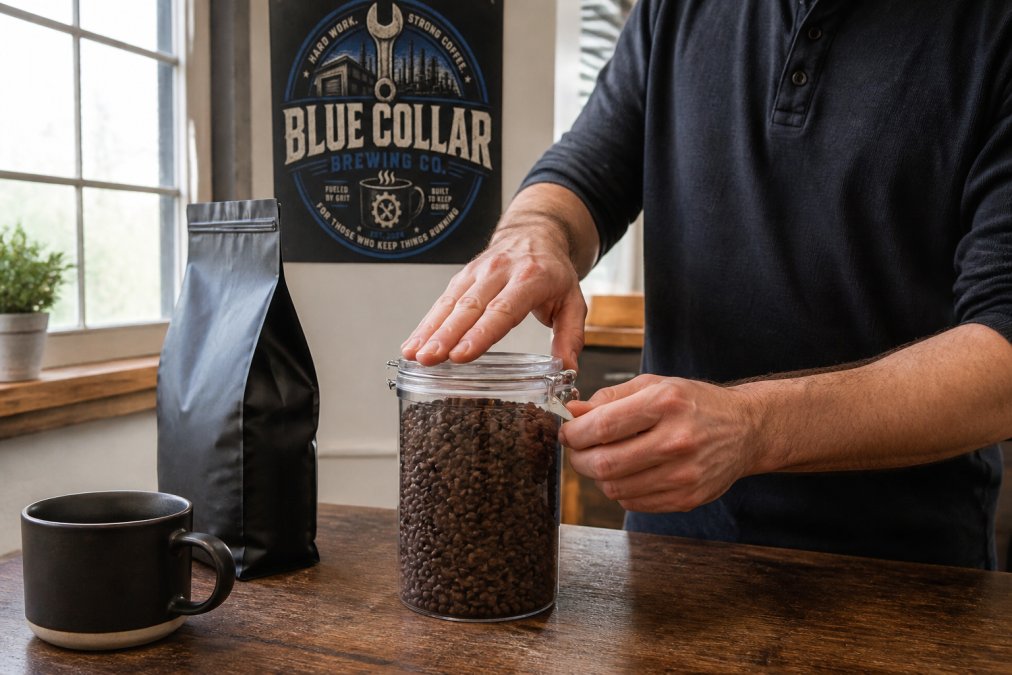
- Transfer beans to an opaque, airtight container within minutes of opening the bag.
- Store that container in a cool, dark cabinet away from the stove and oven.
- Buy in amounts you'll finish within two to three weeks.
- Keep the original bag's roast date so you always know the clock.
- Avoid clear glass jars on open shelves; light degrades the oils.
Container Science: How Each Option Changes the Clock
The container you choose does not just slow staling, it changes the effective "days old" of your coffee. Here is how the main options actually work.
One-way valve bags. These are the bags most specialty roasters ship in. A small valve on the front lets carbon dioxide escape as beans degas, but blocks outside air from getting in. That is why the bag does not balloon and pop on your counter. The valve is a one-way door: gas out, oxygen stays out. For beans still within their first week post-roast, the original valve bag is often the best home they have.
Vacuum-sealed bags. Vacuum sealing pulls nearly all the air out, which removes the oxygen that drives oxidation. The trade-off is that it also removes the headspace the beans need to degas. Seal beans too soon after roasting and the trapped carbon dioxide has nowhere to go, which can pressurize the bag and, in some cases, crush the beans. Vacuum sealing works best for beans that have already rested a few days, or for portions headed straight to the freezer.
Airtight canisters. A good canister with a gasket seal blocks oxygen and moisture, but it does not let carbon dioxide escape. That makes it a poor choice for beans roasted in the last 48 hours, the gas has nowhere to go and can build up pressure when you open the lid. Once beans have finished degassing, an opaque airtight canister is a solid daily-use option.
Original paper bags. Paper is porous. It lets oxygen in and aromatics out. A paper bag on the counter is a short-term solution at best.
| Container Type | Blocks Oxygen | Lets CO2 Escape | Best For |
|---|---|---|---|
| One-way valve bag | Yes | Yes | Freshly roasted beans, first 1-2 weeks |
| Vacuum sealed | Yes | No | Long-term freezing, rested beans |
| Airtight canister | Yes | No | Daily use after degassing |
| Original paper bag | No | Partly | Short-term only |
Room Temperature, Refrigeration, or Freezing?
Room temperature suits beans you'll finish within a couple of weeks. Refrigeration is the trap most people fall into: the fridge is damp and full of odors, and coffee absorbs both, so beans come out tasting like last night's leftovers.
Freezing works, but only if you do it right. Freeze beans in a vacuum-sealed or truly airtight portion, and don't thaw and refreeze repeatedly. Take out what you need, let it come to room temperature before grinding, and leave the rest sealed.
The Storage Rule That Actually Matters
No container beats time. The single biggest freshness lever is buying only what you will drink in two to three weeks. A perfect vacuum seal on a bag roasted two months ago is still a bag of stale coffee. Match your container to your timeline: valve bag for the first week, airtight canister for daily use, freezer for anything you won't touch within a month.
How Roast Profile Changes the Freshness Clock
Roast level shifts how fast coffee fades, and this is where a lot of general advice gets it wrong. Darker roasts carry more surface oil, and oil is what oxygen attacks, so dark roasts tend to peak faster and decline sooner.
Lighter roasts often hold their character longer, though they can taste underdeveloped in the first few days and need more rest to hit their stride. A light roast might peak around day 10 to 14; a dark roast might peak closer to day 4 to 7.
That means the "best by" window isn't one number for all coffee. It depends on how the beans were roasted, which is another reason a printed roast date plus a little sensory judgment beats any single rule.
Adjusting Your Brewing Method as Coffee Ages
Brewing method adjustment keeps older beans drinkable instead of disappointing. As coffee ages, it loses carbon dioxide and moisture, which changes how it extracts. Older beans often taste weak and hollow, so you compensate.
Try these tweaks as beans move past their peak:
- Grind slightly finer to increase surface area and pull more flavor from tired beans.
- Use a touch more coffee per cup to offset fading strength.
- Lower the water temperature a few degrees to reduce bitterness from over-extraction.
- Switch to a method that highlights body, like a French press, when acidity fades.
- Brew smaller batches so you're not stuck drinking a full pot of declining coffee.
For cold brew, older beans matter less because the long, slow steep pulls flavor steadily. It's a forgiving method when your bag is on its last legs.
If you want beans that arrive near their peak instead of past it, Blue Collar Brewing's Whiskey Barrel Aged is roasted to order and rested just long enough to brew well on arrival. It's a straightforward way to skip the guessing game about how old your coffee really is.
Knowing how many days old is fresh coffee gives you control that a date stamp never will. The peak window is short, roughly one to two weeks, and it rewards anyone who stores beans well and pays attention to how they taste. Blue Collar Brewing roasts every batch to order, sources beans from trusted farms, and ships with a simple ordering process so hardworking crews get maximum flavor and aroma without the guesswork. Get started with Blue Collar Brewing and taste what fresh-roasted actually means in the cup.
Frequently Asked Questions
How long does fresh coffee stay fresh?
Fresh coffee hits its peak flavor window between 4 and 14 days after the roast date. Whole bean coffee stays at its best for about 2 to 4 weeks after roasting, while ground coffee loses its peak flavor within 5 to 7 days. After that window, oxidation and moisture slowly degrade the oils, aroma, and flavor profile, though the coffee is still safe to drink for months past the roast date.
Can you drink coffee 3 months after the roast date?
Yes, coffee 3 months past its roast date is safe to drink. It will not make you sick. The flavor, however, will have flattened significantly. The carbon dioxide from the coffee degassing period is long gone, and oxidation has broken down the oils that carry aroma and acidity. You can still brew it, but expect a dull, flat cup with muted body and little of the brightness you would get from fresh coffee.
Why do coffee bags have a roast date instead of an expiration date?
A roast date tells you exactly when the clock started ticking on freshness. An expiration date only tells you the last day a product is safe to consume, which for coffee can be a year or more out. For anyone chasing peak flavor, the roast date is the number that matters. Specialty coffee roasters print it because it lets you calculate how many days old the coffee is before you buy.
Does storing coffee in the freezer extend its freshness?
Freezing whole bean coffee in an airtight, vacuum sealed container can extend its peak flavor window from weeks to several months. The key is to prevent moisture and oxygen from reaching the beans. Use a container with a one-way valve or vacuum seal, and let the beans come to room temperature before grinding. Avoid repeated freeze-thaw cycles, which introduce moisture and speed up oil degradation.