

How to Buy Coffee Online Safely: 2026 Guide
Table of Contents
- Why Buying Coffee Online Is Riskier Than You Think
- Secure Online Shopping Best Practices Before You Enter Payment Info
- How to Identify Fresh Roasted Coffee in an Online Listing
- Best Coffee Subscription Services and How to Cancel Without a Fight
- Shipping, Packaging, and What Arrives at Your Door
- Single-Origin, Blends, and Sample Packs: Picking Your First Order
- Red Flags and Scam Signs When You Buy Coffee Online
- Conclusion
- Frequently Asked Questions
Last Updated: September 14, 2026
Why Buying Coffee Online Is Riskier Than You Think
Ordering beans online is routine, but the convenience creates openings for stale product, vague listings, and checkout pages that were never built to protect your card. This guide from Blue Collar Brewing covers how to buy coffee online safely, both the security and the freshness side.
The risks split into two categories most shoppers never separate. Digital: an unsecured payment page, a seller with no verifiable identity, or a subscription that quietly renews. Physical: beans roasted months ago and shipped in packaging that lets oxygen in. A listing can look polished and still fail on both counts.
The throughline: safety when you buy coffee online is a vetting problem, not a luck problem. Check the seller the way you would check a contractor before handing over a deposit.
Secure Online Shopping Best Practices Before You Enter Payment Info
Secure online shopping best practices start with the connection, not the product. Before you enter payment details, confirm the site uses HTTPS with a valid certificate, shown by the padlock in your browser bar (the FTC). Encryption does not guarantee an honest seller, but its absence is a hard stop.
Next, look at how the site handles payment. Reputable roasters route transactions through an established payment gateway rather than collecting raw card numbers on their own servers. You should see recognized processor branding at checkout, and never be asked to email your card number or read it over the phone.
A short pre-purchase checklist:
-
Padlock present, URL begins with
https:// - Checkout hosted by a known payment processor
- Physical business address listed somewhere on the site
- Contact method that is not just a web form
- Refund or return policy written in plain language
- No pressure to pay by wire transfer, gift card, or crypto
Checkout Signals That Separate Real Roasters From Scams
Real checkout pages are boring, and that is the point. They ask for a name, an address, a card, and nothing unusual. Scam pages add friction in the wrong places: a demand for a photo of your ID, a "verification fee," or a redirect to a third-party page that looks nothing like the store you were browsing.
One more signal: how the site handles your account. A legitimate store lets you check out as a guest or create a password using standard practices. If a site emails you your password in plain text, that tells you how it stores everything else.
How to Identify Fresh Roasted Coffee in an Online Listing
Knowing how to identify fresh roasted coffee comes down to one number: the roast date. Freshness is a countdown, not a permanent quality. Beans begin losing aromatic compounds the day they leave the roaster, and the decline accelerates once the bag is opened.
A listing that shows a roast date, printed on the bag rather than the shipping label, tells you the roaster tracks batches. A listing that only shows a best-by date tells you something less useful.
Roast Date vs. Best-By Date
A roast date is the day the beans finished roasting, the most useful information on a coffee bag, because it tells you exactly how much time has passed since the beans were at their peak.
A best-by date is a manufacturer's estimate of when the product stops being acceptable. It says nothing about when the coffee was roasted, and a bag can carry a best-by date a year out while the beans inside were roasted long before you ordered. When a listing offers only a best-by date, ask the roaster directly for the roast date.
To test a roaster's freshness claims with low risk, a sampler pack lets you try several coffees in small quantities before committing to a full bag. Blue Collar Brewing roasts every batch to order, ensuring maximum flavor, aroma, and character in every cup.
Best Coffee Subscription Services and How to Cancel Without a Fight
The best coffee subscription services are the ones you can leave as easily as you joined. That sounds like a low bar until you try to cancel one. Cancellation friction is the most under-covered part of buying coffee online: the coffee is fine, the billing is the problem.
Friction comes in recognizable forms. The cancellation link sits behind a login you no longer remember. The account page says "contact us to cancel." The contact form routes to a retention queue that replies in two business days. Or the terms require a phone call during a narrow window in a time zone you do not live in. None are illegal, and all are designed to outlast your patience.
How to Measure Exit Difficulty Before You Pay
Run this audit before you enter a card number, not after:
- Find the cancellation page first. Search the site for "cancel," "manage subscription," and "terms." If you cannot locate a self-serve cancellation path in under a minute, treat that as your answer.
- Read the terms for a minimum commitment. Some services require two, three, or six shipments before you can leave. That is a contract, not a preference.
- Check whether you can skip instead of cancel. A skip option is a pressure valve. A service with no skip and no pause bills on a fixed clock.
- Confirm renewal notices. Look for whether the service emails you before each charge or bills silently. Silent renewal is the most common complaint pattern in subscription coffee.
- Test the support channel. Send one pre-sale question through the same channel you would use to cancel. If the reply is slow or evasive before they have your money, expect worse after.
The Cancellation Methods Ranked by Friction
From easiest to hardest to escape:
- Self-serve cancel in account settings, one click, immediate confirmation email. This is the standard to hold every service to.
- Self-serve cancel with a survey step, you click through one or two retention offers. Annoying but survivable.
- Email or web form request, you are now dependent on a human response time. Keep a copy of your request and the date you sent it.
- Phone-only cancellation, the highest-friction model. Note the hours, the number, and the fact that you may be transferred to a retention agent whose job is to talk you out of it.
- Cancellation by mail, rare, but it exists. If you see it in the terms, do not subscribe.
What to Do If You Are Already Stuck
If a service makes cancellation unreasonably difficult, the practical path is documentation, not confrontation. Save your cancellation request, the date, and any confirmation. If charges continue after a documented cancellation, dispute the charge with your card issuer under the fair billing rules covering recurring charges, and cite your cancellation record. Most issuers handle these disputes routinely when you can show you tried to cancel in writing.
A subscription you cannot easily exit is one you should not enter. Treat the cancellation page as part of the product, and judge it before you judge the coffee.
Shipping, Packaging, and What Arrives at Your Door
Shipping transit time is the variable most buyers ignore, and it decides whether your coffee arrives fresh or merely arrives. A roaster can print a roast date on every bag and still hand you stale coffee if the package sits in a distribution center for a week. Stop treating "freshly roasted" as a claim and start treating it as a calculation.
The Freshness Math: Roast Date Plus Transit Time
Roasted coffee has a usable window, and it is shorter than most listings imply. Beans hit their best drinking window roughly 3 to 14 days after the roast date, depending on roast level and brew method (pubmed.ncbi.nlm.nih.gov). Light roasts often need a few days to degas; darker roasts peak sooner and fade sooner. Past roughly four to six weeks, the decline is noticeable even if the bag is sealed (pubmed.ncbi.nlm.nih.gov).
That gives you a simple test before you order:
Roast date + days in transit + days on your shelf = days since roast when you brew.
If that number lands inside the 3-to-14-day window, you are buying fresh coffee. If it lands past four weeks, you are buying the roast date as decoration.
Work an example. A roaster ships two days after roasting, and the carrier takes four days. The bag reaches you at day six; brewing it over the following week puts you between day six and day thirteen, squarely in the window. Now change one variable: the same roaster batches shipments once a week, so your order waits five days before it ships. The bag reaches you at day eleven, and by the time you finish it you are past three weeks. Same beans, same roast date, different outcome.
Questions That Reveal Real Shipping Speed
Ask these before ordering from anyone new:
- How soon after roasting does the order ship? "Within 24 to 48 hours" is a real answer. "Freshly roasted" is not.
- Which carrier, and what is the service level? Ground transit across the country routinely runs four to five business days. Expedited service compresses that, at a cost.
- Where does it ship from? A roaster shipping from the opposite coast adds transit days you cannot recover.
- Is the roast date printed on the bag or the shipping label? The bag is the only one that tells you when the beans were roasted. The label tells you when the box left.
- Does the roaster hold orders to batch them? Batching saves the roaster money and costs you freshness.
Packaging: What Actually Protects the Beans
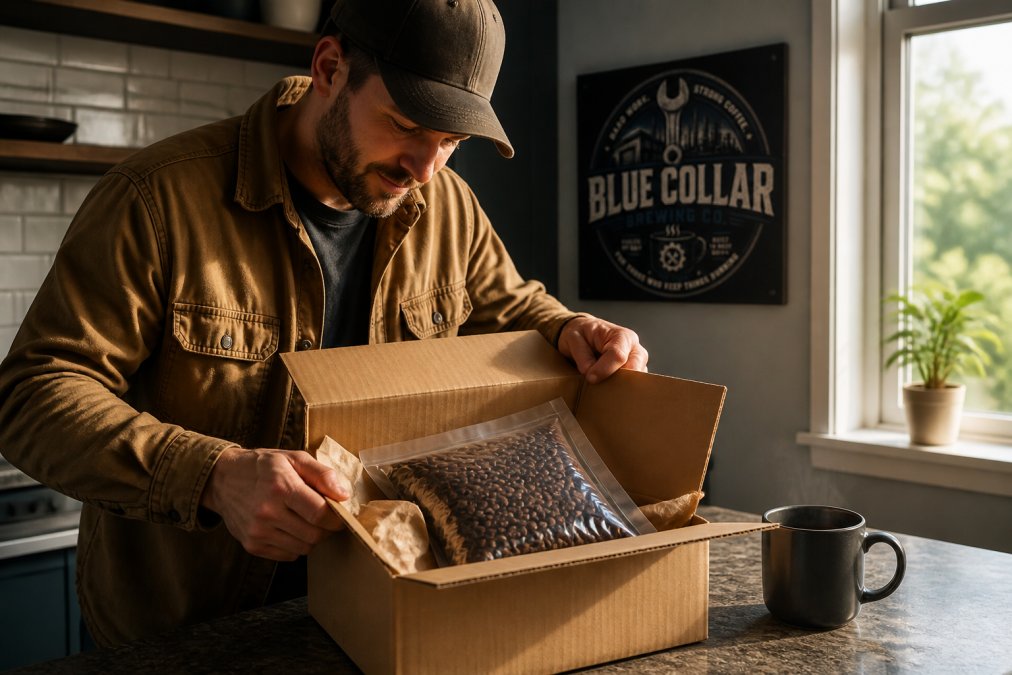
Packaging matters as much as speed, because oxygen dulls roasted coffee. Airtight packaging with a one-way degassing valve lets carbon dioxide escape without letting oxygen in, that valve is the detail to look for on a product photo. A folded bag or container with no seal undercuts everything the roaster did before shipping.
Storage Tips for Online Orders
Once the box is open:
- Keep beans in the original airtight bag or a sealed canister
- Store at room temperature, away from the stove and the window
- Skip the freezer for daily-use beans; moisture and odors migrate in
- Buy in quantities you will finish within a few weeks
- Grind right before brewing to protect the flavor profile
Single-Origin, Blends, and Sample Packs: Picking Your First Order
Single-origin coffee comes from one growing region, making its flavor profile easier to trace and often more distinctive. Blends combine beans from multiple origins, usually for a consistent cup that holds up across brew methods. Neither is better, they answer different questions.
If you want something dependable every morning, a blend is the safer first order. If you want to taste what a specific farm or region produces, single-origin is the point. Many roasters label the processing method too: washed coffees are cleaner and brighter, natural process coffees heavier and fruitier.
| Option | Best For | What You Get | Typical Order Size |
|---|---|---|---|
| Sample pack | First-time buyers testing a roaster | Several small packs, multiple origins | 6 x 2 oz |
| Single-origin | Exploring one region's flavor | One farm or region, traceable | 12 oz bag |
| Blend | Daily drinking, consistency | Multiple origins, balanced cup | 12 oz bag |
| Single-serve capsules | Speed at a job site or truck cab | Pre-portioned, sealed | 12 or 60 count |
Sample packs are the lowest-risk entry point, and they solve a real problem: you cannot judge a roaster from a product page. Blue Collar Brewing offers a Best Sellers Sample Pack, a Single Origin Favorites Sample Pack, and a Flavored Coffees Sample Pack, each at $21.99, so you can explore different flavors before committing to a full-size bag.

Red Flags and Scam Signs When You Buy Coffee Online
Scam listings share recognizable patterns, and most show up before checkout. The clearest sign is a price far below what the market charges for the same weight of specialty coffee. Beans are an agricultural product with real input costs, so a deep discount usually means old stock, mislabeled goods, or no product at all.
Other signs worth treating as disqualifying:
- Stock photos of coffee instead of images of the actual product and packaging
- No business address, phone number, or verifiable company name anywhere on the site
- Reviews that all appeared in the same short window, or reviews only on the seller's own site
- Pressure tactics: countdown timers, "only 2 left," expiring discounts on every visit
- A return policy that does not exist, or one that excludes opened food products entirely
- Requests for payment outside the normal checkout flow
The reverse also holds. A roaster that publishes its sourcing relationships, names the farms or regions it buys from, and carries recognized certifications such as fair trade or organic is giving you something to verify. Traceability is a claim you can check, a useful filter when you buy coffee online from a seller you have never used.
Conclusion
The hard part of buying coffee online is not finding a roaster. It is finding one whose freshness claims, payment handling, and shipping promises all hold up at once. Blue Collar Brewing roasts every batch to order from carefully sourced beans and ships through a simple ordering process built for people who do not have time to chase a delivery. Start with a sample pack, or go straight to a full bag and experience the perfect fuel for your day. Shop Coffee with Blue Collar Brewing and get fuel that shows up fresh.

Frequently Asked Questions
What should I look for when buying coffee beans online?
Check three things before you add to cart: a printed roast date (not just a best-by date), the roast level (light, medium, or dark), and the origin or blend details. A roaster that lists the farm, region, and processing method (washed or natural) is showing traceability. Skip listings that only show stock photos and vague claims like 'gourmet' with no date, origin, or roast level.
How can I tell if a coffee website is secure?
Look for HTTPS in the address bar and a padlock icon before you enter payment details. The checkout should use a recognized payment gateway, and the site should display a physical business address, a phone number, and a working customer service email. If the only way to reach the company is a contact form and the checkout page looks different from the rest of the site, close the tab.
Is it safe to use my credit card on small business coffee websites?
Yes, when the site uses SSL encryption and a mainstream payment processor. Credit cards offer fraud protection that debit cards and peer-to-peer transfers do not. For a first order with an unfamiliar roaster, start small with a sample pack, pay by credit card, and save the confirmation email. That way you have a paper trail if the order never arrives.
How do I avoid subscription cancellation friction?
Before you sign up for any coffee subscription, find the cancellation policy and read it. Look for the words 'cancel anytime' paired with an actual cancel button in your account dashboard. If the only way to cancel is calling during business hours or emailing support, treat that as a warning. A legitimate subscription model lets you pause, skip, or cancel from your account page without contacting anyone.
How fresh is 'roasted to order' coffee when it arrives?
Roasted-to-order coffee typically ships within one to three business days of roasting, and standard shipping adds two to five days in transit. That means most bags arrive between three and eight days off the roast. Coffee tastes best within two to four weeks of the roast date, so check the printed date on the bag when it lands and note how many days passed.
What are the signs of a reputable online coffee roaster?
A reputable roaster publishes a roast date, names the farm or cooperative behind each lot, and explains the processing method. They list a real business address, respond to customer feedback publicly, and offer a refund or replacement policy. If a site claims fair trade or organic certification, the certifier's name should appear on the packaging.
Can I order coffee in bulk for a job site?
Many roasters offer bulk pricing on larger bags or multi-pack orders, and single-serve capsules work well for crews without a grinder. Ask about case pricing before you buy, since per-unit cost drops once you pass a certain volume. Sample packs are a smart first step to confirm the crew likes the roast before you commit to a bulk order.