

Is Organic Coffee Better for the Environment?
Table of Contents
- What Organic Coffee Actually Means
- Pesticide Use in Coffee Production: Organic vs. Conventional
- Shade Grown vs. Sun Grown Coffee and Biodiversity Impact
- Soil Health, Carbon Sequestration, and Sustainable Agriculture
- Sustainable Coffee Certifications: What They Actually Guarantee
- The Hidden Costs: Certification, Water Usage, and Carbon Footprint
- Is Organic Coffee Worth It for Your Priorities?
- Frequently Asked Questions
Last Updated: October 4, 2026
What Organic Coffee Actually Means
Organic coffee is grown without synthetic pesticides, herbicides, or chemical fertilizers. It's a certification standard governed by the USDA that requires farmers to follow specific practices for soil health, pest management, and environmental stewardship. But the label alone doesn't tell you whether is organic coffee better for the environment, that depends on how it was grown, where it came from, and what certifications back it up.
Some organic operations are genuinely sustainable; others cut corners within the rules. The difference matters when you're trying to figure out if organic coffee is better for the environment.
USDA organic certification prohibits synthetic pesticides and chemical fertilizers, but doesn't mandate shade-grown practices or carbon-neutral operations. An organic farm can still be a monoculture on cleared land, undermining expected environmental benefits.
Pesticide Use in Coffee Production: Organic vs. Conventional
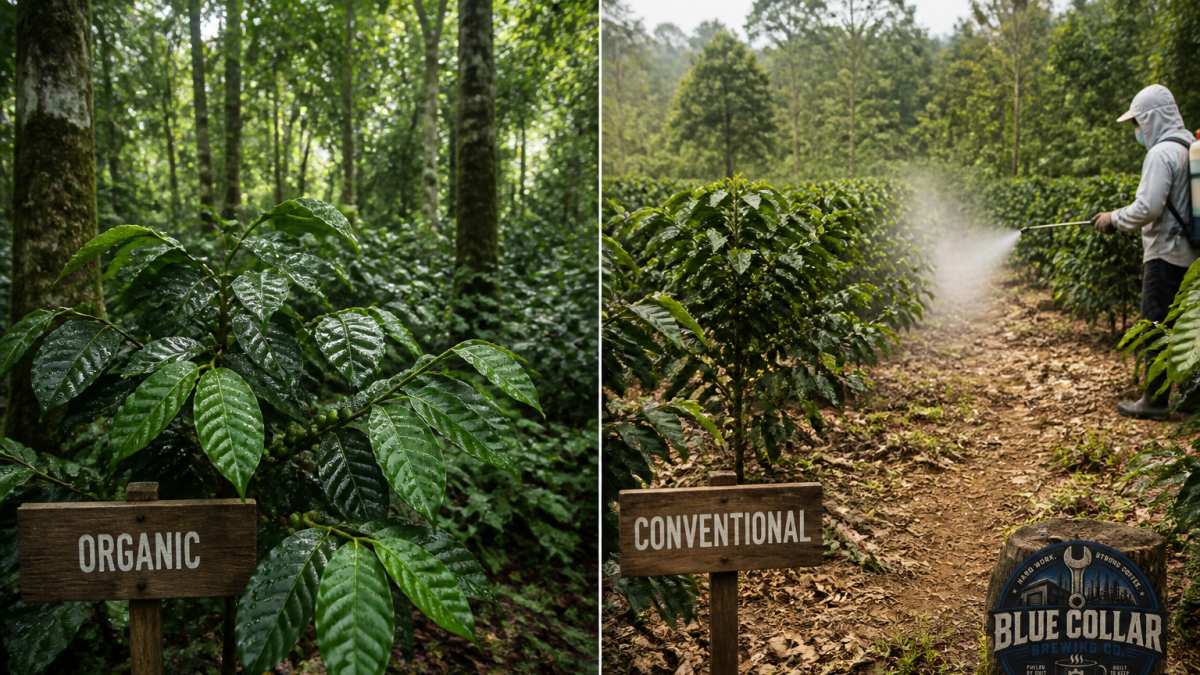
Conventional coffee farming relies heavily on synthetic pesticides and chemical fertilizers to maximize yield. These chemicals accumulate in soil and water runoff, persisting for years and contaminating groundwater while affecting non-target organisms.
Organic farms prohibit synthetic inputs, relying instead on natural fertilizers, crop rotation, and integrated pest management. However, organic doesn't mean pesticide-free; many organic farms use approved natural pesticides like neem oil or sulfur compounds, which are less toxic but still require application.
Shade Grown vs. Sun Grown Coffee and Biodiversity Impact
Sun-grown coffee farms clear forest canopy to maximize yield, requiring more chemical inputs but producing higher volumes per acre. The environmental cost is severe: habitat loss, reduced biodiversity, and increased soil erosion.
Shade-grown coffee preserves forest canopy or plants coffee beneath native trees, supporting pollinator habitats, bird populations, and soil microorganisms. The forest structure provides natural pest control, reduces chemical inputs, and creates carbon sequestration and water retention.
Many organic farms use shade-grown methods, but not all do. The intersection of organic certification and shade-grown practices represents the strongest environmental choice.
Shade-grown coffee farms support significantly more bird species and insect biodiversity than sun-grown operations, protecting critical habitat for migratory birds and endemic species.
Soil Health, Carbon Sequestration, and Sustainable Agriculture
Conventional coffee farming degrades soil through monoculture cropping and heavy chemical use. Chemical fertilizers provide immediate nutrients but don't build soil structure, depleting fertility and increasing erosion risk over time.
Organic farming builds soil health through natural fertilizers, crop rotation, and reduced tillage. Shade-grown systems accumulate leaf litter, feeding soil microorganisms and improving water retention while storing more carbon.
Shade trees in agroforestry systems capture atmospheric carbon and store it in biomass and soil. A well-managed shade-grown farm sequesters more carbon than a sun-grown operation, though amounts vary by tree species, farm age, and management.
Sustainable agriculture in coffee production means building systems that maintain or improve soil fertility without synthetic inputs. Many small-scale organic farmers practice this intentionally; larger operations sometimes treat organic as a label without changing underlying practices.
Sustainable Coffee Certifications: What They Actually Guarantee
The USDA organic label guarantees no synthetic pesticides or chemical fertilizers, but doesn't address water usage, carbon footprint, worker welfare, or farming method. An organic sun-grown monoculture on cleared land meets the same standard as an organic shade-grown agroforestry system, despite vastly different environmental outcomes.
Fair Trade certification prioritizes economic sustainability for farmers through minimum prices and labor standards, but doesn't mandate environmental practices. A Fair Trade coffee can be conventionally grown with synthetic pesticides. Fair Trade addresses social sustainability (farmer welfare, labor rights) while organic addresses environmental sustainability (chemical reduction, soil health). Many consumers conflate the two, assuming Fair Trade is automatically better for the environment, which is inaccurate.
Rainforest Alliance certification focuses on biodiversity, ecosystem health, and sustainable agriculture. Unlike organic, it doesn't prohibit synthetic pesticides entirely but requires integrated pest management and reduction. Standards mandate shade-growing, water conservation, and soil health management with rigorous third-party annual audits. Rainforest Alliance is more stringent on environmental outcomes than USDA organic but less restrictive on chemical inputs.
Bird-Friendly certification, administered by the Smithsonian Migratory Bird Center, is the most specific environmental standard. It requires shade-grown practices with strict canopy requirements: minimum 40% shade coverage, at least 10 native tree species, and 8 meters of canopy height. It also requires organic practices and includes on-site audits and canopy measurements. Bird-Friendly coffee is rare and commands a premium price, but represents the strongest environmental choice for biodiversity protection.
Other certifications exist with varying rigor. Some are independently audited; others rely on self-reporting. A coffee bag can carry multiple certifications, each addressing different priorities. However, multiple certifications don't guarantee better environmental outcomes; they indicate the farm meets multiple standards, which may or may not overlap.
| Certification | Primary Focus | Environmental Rigor | Chemical Inputs | Verification Method |
|---|---|---|---|---|
| USDA Organic | No synthetic chemicals | Moderate | Prohibited | Annual audit |
| Fair Trade | Worker welfare & pricing | Low | Allowed (unless organic) | Supply chain verification |
| Rainforest Alliance | Biodiversity & ecosystem | High | Reduced via IPM | Third-party annual audit |
| Bird-Friendly | Shade-grown bird habitat | Very High | Prohibited (organic required) | On-site audit + canopy measurement |
The most common mistake is treating "certified organic" as the gold standard for environmental impact. Organic certification reduces synthetic chemical pollution and supports soil health, but doesn't guarantee shade-growing, biodiversity protection, water conservation, or carbon sequestration. If your priority is reducing synthetic pesticide pollution, organic is sufficient. If it's biodiversity and ecosystem health, Rainforest Alliance or Bird-Friendly adds critical specificity. Understanding which certification aligns with your environmental values helps you make an intentional choice.
The Hidden Costs: Certification, Water Usage, and Carbon Footprint
Organic certification carries real financial barriers. USDA certification requires a three-year transition period during which farms follow organic practices but cannot label coffee as organic, creating cash-flow burdens for small operations. Certification costs $500-$2,000 annually plus documentation and inspector fees. For a farmer earning $2,000-$4,000 per acre annually, this represents 5-25% of gross income. Many genuinely sustainable small-scale farms operate without the organic label, while larger operations absorb costs and market themselves as organic with minimal practice differentiation. The "organic" label often reflects farm size and financial capacity more than environmental superiority.
Coffee production requires approximately 140 liters of water per cup when accounting for irrigation, processing, and plant growth. Shade-grown farms retain soil moisture significantly better due to forest canopy cover and accumulated organic matter, requiring 20-30% less irrigation than sun-grown operations. In water-stressed regions like Central America and East Africa, this distinction directly impacts community water access. Organic farming practices improve soil water-holding capacity by 15-25%, but organic certification doesn't mandate shade-growing or water conservation, so an organic sun-grown farm may consume as much water as a conventional operation.
Farming method matters less than shipping and roasting to total carbon impact. Lifecycle assessments show farming and processing account for 40-50% of emissions, transportation 30-40%, and roasting and packaging 10-20%. Shade-grown farms sequester 1.5-3 metric tons of CO₂ equivalent per hectare annually versus near-zero on sun-grown monocultures. However, air shipping adds 0.5-1 kg CO₂ per kilogram of coffee, often negating farming advantages. Roasting fresh to order eliminates storage emissions and reduces total footprint by 5-10%.
The intersection of these factors creates a hierarchy of environmental impact. Organic certification alone reduces synthetic pesticide pollution and supports soil health but does not address water usage or carbon footprint. Shade-grown practices reduce water demand and sequester carbon but are not guaranteed by organic certification. Transparent sourcing and sea-freight shipping reduce carbon impact. Fresh-roasted, roasted-to-order models eliminate storage emissions. The most environmentally responsible choice combines organic certification, shade-grown practices, sea-freight shipping, and fresh roasting, but this combination is rare, expensive, and requires intentional sourcing. Understanding these trade-offs helps you evaluate whether a coffee's environmental claims match its actual practices.
Is Organic Coffee Worth It for Your Priorities?
The answer depends on what environmental impact matters most to you. If synthetic pesticide reduction is your priority, organic is worth it. If biodiversity and ecosystem health matter most, shade-grown organic with third-party verification is worth the premium. If carbon footprint is your concern, sourcing method and roasting freshness matter as much as certification.
Many people assume organic automatically means environmentally better. The data is more nuanced. Organic farming reduces chemical pollution and supports better soil health. Shade-grown practices support biodiversity. But an organic, sun-grown coffee farm on cleared land is better than conventional in some ways and worse in others compared to a small-scale shade-grown conventional operation.
The most environmentally responsible choice combines organic certification with shade-grown practices and transparent sourcing. This combination addresses synthetic pesticide reduction, biodiversity protection, soil health, and carbon considerations simultaneously.
According to USDA National Organic Program standards, organic certification requires documented compliance with specific practices, but compliance doesn't guarantee environmental superiority across all metrics. Water usage, carbon footprint, and biodiversity impact require additional research beyond the label.
Research from Smithsonian Migratory Bird Center shade-grown coffee studies shows that shade-grown coffee farms support significantly higher bird diversity than sun-grown operations, with measurable benefits for migratory species.
Blue Collar Brewing roasts to order, ensuring maximum freshness when your coffee arrives. When you prioritize organic coffee, you're making a choice about the environmental practices you support. Understanding what that choice actually means helps you spend your money where it matters most.
Is organic coffee better for the environment? The honest answer is: it depends on what you're measuring and which organic farm you're buying from. Organic certification reduces synthetic pesticide use and supports better soil health, both genuine environmental benefits. Shade-grown organic coffee with third-party biodiversity certification represents the strongest environmental choice. But the label alone doesn't guarantee the outcome you expect. When you're choosing between options, look beyond "organic" to understand the farming method, certifications, and sourcing transparency. At Blue Collar Brewing, we help you make that choice by roasting fresh to order, ensuring you get coffee that tastes better and aligns with your environmental priorities.
Frequently Asked Questions
Does organic coffee mean it's completely pesticide free?
No. Organic coffee prohibits synthetic pesticides and chemical fertilizers, but farmers can use natural pesticides like copper sulfate and rotenone. These are less persistent than synthetic options, but residues can still be present. The USDA organic certification ensures compliance with approved methods, not zero pesticide content. Roasting also reduces any remaining residues significantly.
What's the environmental difference between shade-grown and sun-grown coffee?
Shade-grown coffee preserves forest canopy and supports biodiversity, including pollinator habitats and bird populations. Sun-grown coffee requires clearing trees and relies more on chemical fertilizers and pesticides to maintain soil fertility. Shade-grown farms also improve carbon sequestration and reduce water runoff, though they typically produce lower yields per acre, which affects farming economics.
How much does organic certification actually cost farmers, and does that affect you?
Organic certification costs $500-$2,000 annually for small farms, plus transition costs of 2-3 years with reduced yields. These expenses are often passed to consumers through higher prices. However, certification also opens access to premium markets and fair trade partnerships, which can offset costs. Understanding this barrier helps explain price differences between organic and conventional options.
Is organic coffee really better for the environment than fair trade or sustainably farmed coffee?
Organic focuses on eliminating synthetic inputs, while fair trade prioritizes worker wages and community investment, and sustainable certification covers broader environmental practices. These certifications overlap but measure different things. Organic coffee can still use monoculture farming methods that harm biodiversity. The most environmentally beneficial coffee often combines organic methods with shade-grown practices and agroforestry, which may or may not carry all three certifications.