

Reliable Coffee Delivery for Truck Drivers: 2026 Guide
Table of Contents
- Why Truck Stop Coffee Falls Short on Long Hauls
- Reliable Coffee Delivery for Truck Drivers: How It Actually Works
- High Caffeine Coffee for Night Shifts: What to Order
- Portable Coffee Makers for Semi Trucks That Fit a Sleeper Cab
- Caffeine Management for Professional Drivers
- Storing Coffee in Extreme Cab Temperatures
- What a Coffee Delivery Setup Costs Per Cup
- Frequently Asked Questions
Last Updated: September 11, 2026
Why Truck Stop Coffee Falls Short on Long Hauls
The problem with truck stop coffee isn't the price, it's what happens 90 minutes later. Most roadside pots sit on a hot plate for hours, scalding the brew and stripping out the oils. What's left is a thin, acidic cup that hits hard and fades fast.
That matters more than most drivers admit. Drowsy driving is a genuine safety issue on long hauls, and coffee is one of the few tools a driver can use without pulling over. Bad coffee makes you drink more for the same effect, more sugar, more creamer, and a harder crash by mid-afternoon.
A common mistake is treating every cup as interchangeable. It isn't. Fresh grounds, correct water temperature, and a clean brewer change the outcome more than the brand on the bag. NHTSA guidance on drowsy driving is clear that fatigue impairment is comparable to alcohol impairment, which is why the quality of what you're drinking matters as much as the quantity.
Reliable Coffee Delivery for Truck Drivers: How It Actually Works
Reliable coffee delivery for truck drivers works by shipping fresh-roasted beans or single-serve capsules to a fixed address you'll actually return to: a terminal, a home base, or a fuel stop that accepts packages for drivers. You order ahead, it's waiting when you arrive, and you never depend on the next exit.
Shipping to a Terminal, Home Base, or a Fuel Stop
The logistics are simpler than they sound. Most carriers have a terminal or yard where packages can be received and held, and owner-operators can use their home base. Independent drivers on fixed routes can often arrange delivery to a fuel stop that already handles driver mail, confirm with the location first.
Blue Collar Brewing roasts every batch to order and ships it out, so the coffee that lands at your terminal is days old, not months. That's the point: stop gambling on whatever's in the pot and control what's in your cab.

The practical checklist for setting this up:
- Pick one fixed delivery address you hit at least every two weeks
- Confirm the location will hold packages for you
- Order enough to cover the gap between stops, plus a buffer
- Keep a backup stash in the cab for delays
- Store the backup somewhere it won't cook in the sun
High Caffeine Coffee for Night Shifts: What to Order
High caffeine coffee for night shifts should come from a dark roast or a blend built with Robusta beans, which carry more caffeine per scoop than Arabica alone. The bean matters more than the roast, though darker roasts hold up better to cab brewing.
For overnight drivers, the goal isn't maximum caffeine in one cup, it's a steady supply you can meter across a shift so you don't spike and crash. Added Robusta lets you drink less and stay sharp.
Blue Collar Brewing's Max Caf Blend is built exactly for this: a high-caffeine blend of Tanzania and India Robusta. The Breakfast Blend + adds Robusta to a medium house roast for extra caffeine without the burnt edge. The 60 Pack Single Serve Coffee Capsules at $59.99 give you a sealed, no-oxygen format that keeps grounds fresh in a cab where temperatures swing constantly.

| Option | Caffeine Profile | Best For | Format |
|---|---|---|---|
| Max Caf Blend | High, Robusta-forward | Overnight shifts, long hauls | Ground |
| Breakfast Blend + | Medium-high, Robusta added | Early mornings, mixed shifts | Ground |
| 60 Pack Single Serve Capsules | Medium, consistent | Drivers who want no clean-up | Capsule |
| Instant Coffee | Medium, fast | Emergency backup in the cab | Resealable pouch |
Portable Coffee Makers for Semi Trucks That Fit a Sleeper Cab
Portable coffee makers for semi trucks need three things: a small footprint, a power source that matches your cab, and a clean-up process you'll actually do at a rest stop. Fail one and it ends up in a drawer.
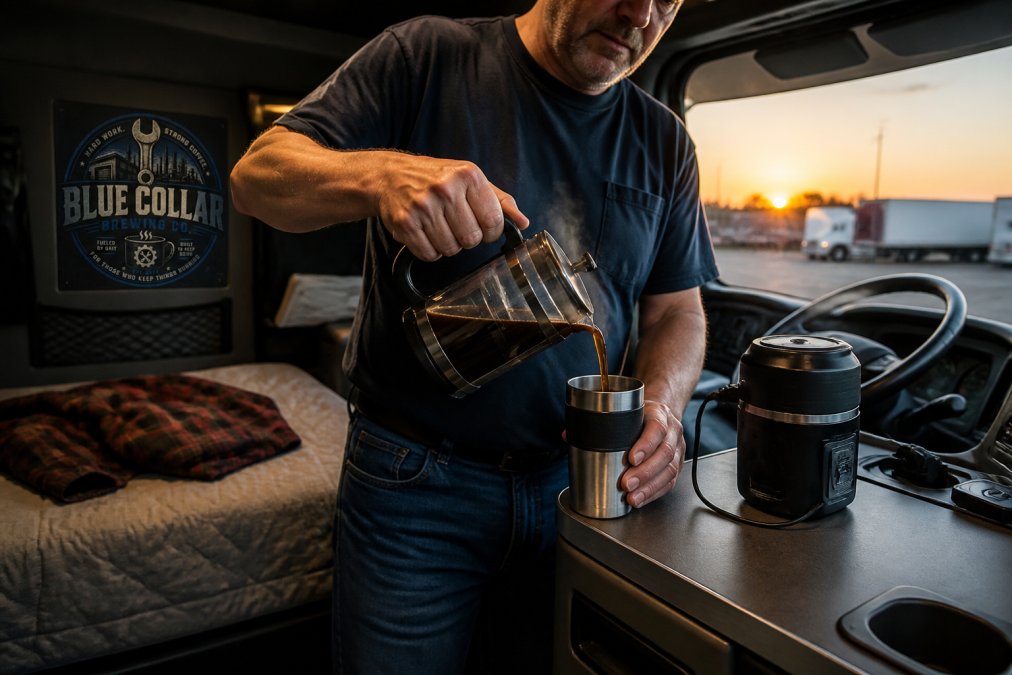
The two formats that survive cab life are the French press and the single-serve capsule brewer. A French press needs no power, just hot water and a rinse. A capsule brewer needs a 12-volt outlet or small inverter, but produces a cleaner cup with zero grounds.
12-Volt Brewers, Power Inverters, and Clean-Up
A 12-volt brewer draws from your cab's accessory socket, with slower brew times and smaller cups. A power inverter runs a standard small brewer, but size it to the brewer's wattage and confirm your battery handles the draw when the engine's off.
Clean-up is where most setups fail. Capsules win: no grounds, no filter rinsing, no wet paper towels in a trash bag. A French press needs a rinse and a place to dump grounds, fine at a fuel stop, miserable on the shoulder.
Caffeine Management for Professional Drivers
Caffeine management for professional drivers comes down to timing and dose, not willpower. Most drivers either drink too much too fast or wait until they're already fading, both produce a spike, a crash, and a worse stretch of road than nothing.
The workable approach: spread intake across the shift, a cup at the start, another at the midpoint, a small one before the hardest stretch. That keeps blood caffeine steady instead of spiking and dropping.
The Digestion Problem Nobody Talks About
Here's the part the coffee conversation on the road skips: high-acidity coffee hits differently after six hours of sitting. A dark, over-extracted roadside cup is more acidic than a properly brewed one, and combined with seated posture and eating on the move, that acidity commonly triggers reflux and gut discomfort.
The fix isn't quitting coffee, it's changing what you brew. Lower-acid options include cold brew, medium roasts over dark, and Arabica-heavy blends over Robusta-heavy. If you run a high-caffeine Robusta blend for night shifts, know the trade-off: more caffeine per scoop, but also more compounds that bother a sensitive stomach.
A practical pattern many drivers land on: high-caffeine blend for the hardest stretch, lower-acid medium roast for the rest. You get alertness where you need it without paying in discomfort for eight hours.
Hydration Is Not Optional
Hydration is the part drivers skip, and it determines whether caffeine helps or hurts. Caffeine is a mild diuretic, and a hot cab plus coffee plus no water means headaches, false fatigue, and fuzzy focus that feels like tiredness but is mild dehydration.
The math is simple: for every cup of coffee, drink a cup of water. Keep a refillable bottle within reach of the driver's seat, not buried in the sleeper. Water between cups keeps caffeine working the way you want instead of turning into a headache by mile 400.
The Coffee Nap
The coffee nap is the other tool worth knowing. Drink a cup, then sleep for 15 to 20 minutes. Caffeine takes about that long to peak, so you wake up as it kicks in. It sounds backward, and it works. CDC information on shift work and fatigue notes that shift workers face elevated fatigue risk, which makes these small timing tricks worth the effort.
Storing Coffee in Extreme Cab Temperatures
Coffee stored in a cab goes stale faster than coffee stored at home, and heat is the reason. A sleeper cab in direct sun accelerates oxidation of the oils in the grounds, turning fresh coffee flat and papery, a storage problem almost no coffee guide for drivers addresses.
What Heat Actually Does to Coffee
Coffee freshness is a race against oxygen, heat, and light, and heat is the accelerator. Every 10-degree increase in storage temperature roughly doubles the rate of the reactions that stale coffee, so a bag in a 100-degree cab ages several times faster than one in a 70-degree cabinet. Over a two-week run, that's the difference between coffee and cardboard.
Temperature swing matters too. A cab that bakes at 110 degrees midday and drops to 40 overnight repeatedly expands and contracts the air inside a bag, pulling fresh air in and pushing stale air out, exactly the oxygen exposure you're trying to avoid.
Where to Store It in the Cab
The fix is keeping the bulk of your supply out of heat and light. Store sealed bags or capsules in a closed, opaque container in the darkest, coolest spot in the cab, the sleeper floor, under the bunk, or a closed cabinet below the window line all beat the dash, door pocket, or sunny overhead shelf.
Don't leave a bag open on the dash. Don't store coffee next to a heater vent. Don't keep your daily supply in a clear container on a sunny shelf. These are the three mistakes that kill a bag fastest.
Format Matters More Than You Think
Capsules have a real advantage here. The 60 Pack Single Serve Coffee Capsules are sealed with no oxygen inside, slowing staleness even when the cab gets hot, and the coffee isn't exposed to the air cycling that hits an open bag. A resealable pouch like the Instant Coffee format works too, if you reseal it and press the air out every time.

Whole bean holds up better than pre-ground in heat, because the oils stay protected inside the bean until you grind. If you run a French press or pour-over, buying whole bean and grinding per cup is the biggest freshness win available in a cab. Ground coffee exposes far more surface area to oxygen, so it stales faster, and heat widens that gap.
What a Coffee Delivery Setup Costs Per Cup
The per-cup cost of a delivery setup is usually lower than truck stop coffee, and the gap widens the more you drink. That's the part most drivers don't run the numbers on.
Break it down honestly. A 12 Pack Single Serve Coffee Capsules runs $18.99, roughly $1.58 per capsule. The 60 Pack at $59.99 brings that to about $1.00 per cup. A bag of Max Caf Blend or Cowboy Blend at $19.99 brewed at two scoops per cup yields far more cups than a capsule pack at the same price, which is why drivers who brew their own come out ahead.
Truck stop coffee looks cheap at the register, but the real cost includes the second cup you buy because the first was bad, the creamer and flavor shots, and time in line. Add those up over a week and the delivery setup is cheaper, and it's the one you control.
| Format | Price | Approx. Cost Per Cup | Best For |
|---|---|---|---|
| 60 Pack Capsules | $59.99 | About $1.00 | Daily drivers, no clean-up |
| 12 Pack Capsules | $18.99 | About $1.58 | Testing the format |
| Max Caf Blend | $19.99 | Lowest per cup | High-caffeine shifts |
| Instant Coffee | $19.99 | Low, 30 servings | Backup supply |
USDA information on coffee and caffeine is a useful reference if you want to check caffeine content against your own intake.
The hard part of coffee on the road was never the coffee itself. It's the logistics: power, storage, clean-up, and getting a fresh supply to a place you'll actually be. Blue Collar Brewing roasts every batch to order and ships it where you need it, with a lineup built for long shifts in tight spaces. The Max Caf Blend covers overnight hauls, the 60 Pack Single Serve Coffee Capsules handle clean-up in seconds, and the sealed format holds up to cab heat. Get started with Blue Collar Brewing and stop settling for whatever's been sitting on the burner.
Frequently Asked Questions
How can truck drivers get fresh coffee delivered to their route?
Set up a recurring order that ships to a fixed address you pass regularly, such as a terminal, home base, or a fuel stop that accepts packages for drivers. A 60-pack of single-serve capsules ($59.99) lasts roughly two to four weeks depending on how many cups you drink per shift, so you can time reorders around your route cycle instead of hunting for a store. Keep a 12-pack ($18.99) in the cab as a buffer between shipments.
What are the best portable coffee makers for semi-trucks?
Look for three things: a footprint under about 20 centimeters, a 12-volt or manual power source, and parts that rinse clean with a cup of water. A small French press or a single-serve capsule brewer fed by a power inverter covers most cabs. Avoid anything with a glass carafe, since it will not survive potholes or a hard brake. Pair the brewer with a sealed travel mug that holds heat for at least four hours.
What is the best high-caffeine coffee for night shifts?
Blends that include Robusta beans carry more caffeine per scoop than straight Arabica. A high-caffeine blend built on Tanzania and India Robusta gives you a stronger cup without brewing a larger volume, which matters when cab space and water are limited. If you want extra caffeine with a familiar breakfast taste, a medium roast with added Robusta is a good middle ground. Match the strength to the length of your shift, not to habit.
How do professional drivers maintain coffee quality while living in a cab?
Keep grounds sealed and away from heat and sunlight, since a cab can swing from freezing to over 38 degrees Celsius in a single day. Single-serve capsules sealed without oxygen hold their flavor longer than an open bag. Clean your brewer after every use so old oils do not turn bitter, and store your mug empty with the lid off overnight so it does not sour. Fresh grounds and a clean brewer do more for taste than any upgrade.
Are there coffee delivery services that cater specifically to long-haul drivers?
Yes, but the practical setup matters more than the label. What works is a roaster that ships on a predictable schedule and offers pack sizes that match your time on the road. Order a large pack for your main supply and a small pack for gaps, and confirm the shipping window before you commit. Ask whether orders ship within a day or two of roasting, because flavor drops off quickly after that.