

Fresh Roasted Coffee Delivery: What Actually Matters
Table of Contents
- What Makes Fresh Roasted Coffee Delivery Different
- Roast-to-Order vs. Pre-Roasted: Why Timing Matters
- Best Coffee Subscriptions: Monthly Delivery Plans That Work
- Coffee Beans Delivered Monthly: Pricing and Total Cost
- How to Store Freshly Roasted Coffee for Maximum Flavor
- Whole Bean vs. Ground: What Works for Your Brew Method
- Shipping Speed and Delivery Reliability: What to Expect
- Frequently Asked Questions
Last Updated: October 16, 2026
What Makes Fresh Roasted Coffee Delivery Different
Fresh roasted coffee delivery isn't just another subscription service. It's the difference between a bag that smells like cardboard and one that fills your kitchen with aroma, beans roasted days, not months, before they arrive.
The key distinction is roast-to-order timing. Most coffee sits in warehouses for weeks after roasting, losing the volatile compounds that make it worth drinking. Fresh roasted coffee delivery services roast after you order and ship immediately, preserving complexity and brightness.
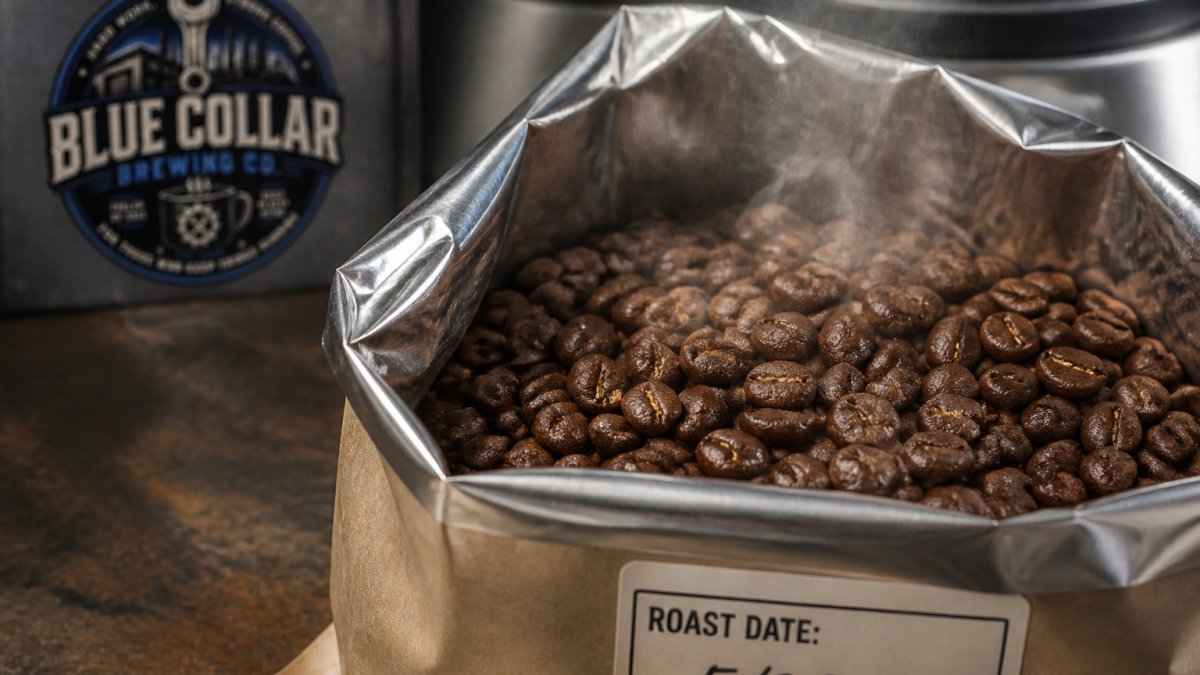
At Blue Collar Brewing, we roast to order because the difference matters for people who work hard and deserve better than stale coffee. You get beans roasted within 24 hours of shipment, delivered consistently.
Roast-to-Order vs. Pre-Roasted: Why Timing Matters
Roast-to-order means your beans are roasted after you order, not weeks before. Pre-roasted coffee is roasted in bulk and stored until someone buys it.
When coffee comes off the roaster, it releases carbon dioxide and volatile aromatic compounds over the next 2-3 weeks, the "bloom" phase. During this window it tastes bright, complex, and alive. After 3-4 weeks those compounds have dissipated, and the coffee tastes flat and dull compared to what it could be.
Pre-roasted coffee sitting in a warehouse for a month has already moved past the bloom phase by the time it reaches you. Roast-to-order coffee arrives during peak flavor, a difference noticeable even to non-experts.
Roast-to-order also means beans roasted to the profile you ordered.
Best Coffee Subscriptions: Monthly Delivery Plans That Work
Coffee subscriptions solve the consistency problem: order once, then coffee arrives on a schedule you set. No running out, no forgetting to reorder.
The best subscriptions offer flexibility on frequency and quantity, and let you adjust without penalties or long-term commitments.
Blue Collar Brewing offers one-time orders to test before committing, or monthly delivery you can pause or adjust anytime. The model keeps fresh roasted coffee delivery flowing without the friction of remembering to order.
The real value isn't the discount, most subscriptions offer modest savings. It's the reliability: coffee arrives without thinking about it, and for people working long shifts or managing job sites, that consistency matters more than saving a dollar per bag.
Coffee Beans Delivered Monthly: Pricing and Total Cost
Most fresh roasted coffee delivery services advertise a per-bag price and stop there. That number is not what you pay. The real comparison is total cost of ownership: per-ounce price after shipping, subscription discounts, and the bags you actually drink in a month.
Start with per-ounce, not per-bag
Bag sizes vary, so convert every price to per-ounce. A $19.99 12-ounce bag is about $1.67 per ounce; a $21.99 2oz sample pack is about $1.83 per ounce.

| Bag size | Example price | Per-ounce cost |
|---|---|---|
| 12 oz | $19.99 | ~$1.67/oz |
| 12 oz | $21.99 (sample pack, multiple origins) | ~$1.83/oz |
| 16 oz | $24.99 | ~$1.56/oz |
Add shipping and any minimum order
Shipping is the line item most buyers forget.
- Calculate landed cost per shipment. Add the bag price, shipping, and any applicable sales tax, then divide by the number of ounces in the box. That is your true per-ounce cost.
- Check the free-shipping threshold. Many services waive shipping above a set order value. If the threshold is close to what you already buy, adding one more bag can drop your effective shipping cost to zero.
A common pattern is a free-shipping threshold between $35 and $50. If your typical order sits just below it, rounding up often costs less than paying shipping on a smaller order.
Account for subscription discounts honestly
Subscription discounts are real but modest. Before you commit, confirm:
- The recurring price after any promotional period ends.
- Whether the discount applies to every shipment or only the first.
- Whether pausing or skipping a shipment changes your discount tier.
Build a monthly total
Total monthly cost depends on consumption, not sticker price. A heavy daily drinker goes through roughly 1 pound per week, about 4 bags of 12-ounce coffee per month. At $19.99 per bag that's roughly $80 before shipping. Consolidating into fewer, larger shipments is often the biggest lever.
Compare that against what you already spend. A $6 to $8 coffee-shop cup five days a week runs $120 to $160 per month. Fresh roasted coffee delivery at home usually lands below that with better flavor, but only if you account for shipping and order frequency.
One-time orders are the right way to test a service before committing. A sample pack that lets you try several origins is worth the modest premium because it prevents locking into a subscription for coffee you don't like.
How to Store Freshly Roasted Coffee for Maximum Flavor
Storage is where most people waste the advantage of fresh roasted coffee delivery. Proper storage keeps coffee at peak flavor for 3-4 weeks. Poor storage degrades it in days.
Coffee's enemies are air, light, heat, and moisture. Store beans in an airtight container away from sunlight and heat, a kitchen cabinet away from the stove works.
Whole beans stay fresher longer than ground. Grinding exposes more surface area to oxygen, accelerating oxidation, so grind immediately before brewing. If you must buy pre-ground, use it within a week.
Keep beans in an airtight container, and seal tightly.
The roast date matters for storage. Coffee is optimal from day 5, after the bloom develops, through day 21; after day 30, degradation becomes noticeable. Ordering fresh roasted coffee delivery monthly catches the optimal window.
Whole Bean vs. Ground: What Works for Your Brew Method
Whole-bean coffee gives you control over when and how fine to grind. Ground coffee is convenient but trades flexibility for freshness, so with fresh roasted coffee delivery, whole bean usually wins.
Brew methods extract differently, which affects grind size. Espresso needs a fine, consistent grind; French press needs coarse grounds; pour-over works with medium-fine; drip typically uses medium.
Grinding at home lets you dial in the exact grind for your method and gets you 2-3 extra weeks of peak flavor compared to pre-ground. The trade-off is you need a grinder.
If you have a grinder and a few extra seconds in the morning, whole bean is the play. If you're rushing out before dawn, coffee ground fresh to order still beats pre-ground sitting on a shelf.
Shipping Speed and Delivery Reliability: What to Expect
Shipping speed and service policy are where fresh roasted coffee delivery services are easiest to compare and hardest to fake. Freshness claims are marketing until you check the dispatch window, the tracking, and what happens when a shipment goes wrong.
Roast-to-ship window
The clock that matters is the gap between roast date and ship date, not transit time. A service that roasts and ships within 24 hours keeps coffee inside its peak flavor window when it arrives; one that roasts in bulk and ships days later has already spent part of that window in a warehouse. Check the roast date on the bag against the delivery date on your first order.
Transit time and coverage
Track your first order to learn the pattern for your address, then time reorders against it.
Tracking and delivery notifications
Tracking is how you catch a shipment sitting at a facility or misdelivered before the coffee stales.
Missed delivery, damage, and replacement policy
This is the gap most comparison pages skip. Before you subscribe, confirm the answers to these questions:
- Missed or returned delivery: If a shipment is returned to the roaster because no one was available, will it be reshipped, and at whose cost?
- Damaged bags: If a bag arrives torn or the valve fails, what is the replacement process and timeline?
- Lost shipments: If tracking shows delivered but nothing arrived, what is the claims window?
- Stale-on-arrival: If the roast date on arrival is older than the service's stated window, will they replace it?
Pause, skip, and cancellation terms
Subscription flexibility is a service policy, not a marketing feature. Check three things before you commit:
- Pause and skip: Can you skip a single shipment or pause indefinitely without penalty, and how far ahead must you act?
- Frequency changes: Can you move from every two weeks to every four weeks without restarting the subscription?
- Cancellation: Is cancellation self-service, or does it require a phone call or email? Are there minimum-commitment periods or cancellation fees?
Free shipping and fee structure
Shipping fees change the total cost, so evaluate them alongside the per-bag price. Calculate landed cost per shipment, not per bag.
A simple reliability checklist
Use this list to compare any fresh roasted coffee delivery service on the same terms:
A service that answers all five is easy to trust with a recurring order. A service that answers two or three is asking you to absorb the risk.
Frequently Asked Questions
How fresh is fresh roasted coffee delivery when it arrives at your door?
Roast-to-order delivery means your coffee is roasted within 24-48 hours of shipment. Depending on your location, you'll receive beans that are 3-7 days old from roast date. Peak flavor occurs 5-10 days after roasting, so beans shipped within this window taste noticeably better than pre-roasted coffee sitting in warehouses for weeks or months. Always check the roast date on the bag when it arrives.
Is a coffee subscription worth it compared to buying from a grocery store?
Yes, if freshness and flavor matter to you. Fresh roasted coffee delivery costs $19.99-$21.99 per bag versus $8-$12 for grocery store options, but the taste difference is significant. You get coffee delivered on a schedule that fits your consumption.
Can you choose roast level and grind type with fresh roasted coffee delivery?
Yes. Most fresh roasted coffee delivery services, including sample packs, offer multiple roast profiles from light to dark. You can choose whole beans or ground coffee based on your brewing method. Light roasts preserve origin flavors; dark roasts deliver bold, smooth cups. Whole beans stay fresh longer, but pre-ground coffee is convenient for quick mornings. Select what matches your equipment and schedule.
How often should coffee beans be delivered if I'm the only one drinking?
A typical 12-ounce bag serves 12-15 cups depending on brew strength. If you drink 1-2 cups daily, one bag lasts 1-2 weeks. Monthly delivery works for regular drinkers; weekly or bi-weekly subscriptions suit heavier consumption. You can also place one-time orders without a subscription commitment, giving you flexibility to adjust frequency based on actual usage rather than a fixed schedule.