

How to Brew Better Coffee at Home
Table of Contents
- Start with Fresh, Quality Beans
- Master the Coffee to Water Ratio Chart
- Coffee Grind Size Guide for Every Method
- Get Water Temperature and Extraction Right
- How to Store Coffee Beans for Freshness
- Step-by-Step Brewing Methods That Work
- Troubleshoot Common Flavor Problems
- Budget-Friendly vs. Pro-Level Gear
- Frequently Asked Questions
Last Updated: September 21, 2026
Start with Fresh, Quality Beans
The foundation of great coffee is simple: fresh, quality beans. Everything else follows from this choice.
This is why roasting to order matters. Blue Collar Brewing roasts every batch fresh, so beans arrive days old, not months.
Look for a roast date on the bag. If it says "best by" instead, the roaster is hiding the age. Fresh beans smell alive; stale beans smell flat.
Master the Coffee to Water Ratio Chart
The standard starting point is one part coffee to sixteen parts water by weight (roughly two tablespoons per six ounces). This is a starting point, not a rule.
| Ratio | Coffee Amount | Water Amount | Brew Strength | Best For |
|---|---|---|---|---|
| 1:16 | 1 oz | 16 oz | Standard | Most methods |
| 1:15 | 1 oz | 15 oz | Stronger | Bold preference |
| 1:17 | 1 oz | 17 oz | Lighter | Delicate beans |
| 1:14 | 1 oz | 14 oz | Very strong | French press |
Adjust based on taste: weak or sour means increase coffee; bitter or harsh means reduce it. Use a scale to measure by weight, volume measurements are inconsistent because ground coffee compacts differently by grind size.
Coffee Grind Size Guide for Every Method
Grind size determines extraction speed. Finer grinds expose more surface area and slow water passage; coarser grinds let water pass quickly.
Pour over and drip: medium-fine grind gives water time to pull flavor. French press: coarse grind prevents over-extraction; fine grounds create bitter, muddy coffee. Espresso: very fine, uniform grind ensures even extraction under pressure.
A burr grinder is essential. Blade grinders smash beans into uneven pieces. Some fragments are powder. Some are chunks. Burr grinders cut beans into uniform size.
Get Water Temperature and Extraction Right
The ideal water temperature is 195 to 205°F. Below 195, extraction is too slow and coffee tastes sour and weak. Above 205, extraction is too fast and coffee tastes bitter.
If you don't have a thermometer, boil water and let it cool for 30 seconds.
What Extraction Actually Means
Extraction dissolves flavor compounds from grounds into water, like steeping tea, but with more precise variables.
The three variables, grind size, water temperature, and brew time, all control extraction speed: finer grind = faster extraction, hotter water = faster extraction, longer brew time = more extraction.
Sour coffee = under-extracting; fix by using a finer grind, raising temperature 5°, or brewing longer. Bitter coffee = over-extracting; fix by using a coarser grind, lowering temperature, or shortening brew time.
The Bloom Phase
Bloom is the first 30-45 seconds of brewing. Pour just enough water to saturate the grounds; you'll see them bubble as CO₂ escapes. Fresh coffee contains trapped gases that create air pockets, preventing even water contact. Bloom lets gases escape so water contacts all grounds uniformly, making extraction even and predictable. Skip bloom with old beans and you won't notice; use fresh beans and skip it, and you'll taste the inconsistency.
Controlled Pour After Bloom
Pour slowly and steadily after bloom, using circular motion for pour-over or gentle stirring for French press. Maintain even water level so all grounds contact water equally. Most home brewers pour too fast; brew should take 3-4 minutes for pour-over, 4 minutes for French press. If it finishes in under 2 minutes, you're pouring too aggressively.
How to Store Coffee Beans for Freshness
Keep beans in an airtight container away from light, heat, and moisture. Oxygen causes oils to oxidize and go rancid. A sealed bag with a one-way valve works well; it lets gas escape without letting air in. Blue Collar Brewing ships coffee in bags with this valve.
Store at room temperature, not in the freezer or refrigerator, cold and moisture create condensation that damages beans. Opened bags stay fresh for 2-3 weeks; buy smaller quantities more often.
Step-by-Step Brewing Methods That Work
Pour Over Brewing
Pour over is simple and gives you full control.
You need a dripper, a filter, and hot water. Place the filter in the dripper and rinse it with hot water. This removes paper taste and preheats the dripper.
Add medium-fine ground coffee. Start with the 1:16 ratio. Pour just enough hot water to wet the grounds. Wait 30 to 45 seconds for the bloom.
Pour the rest of the water slowly in circles. Keep the pour steady. The entire brew should take three to four minutes.
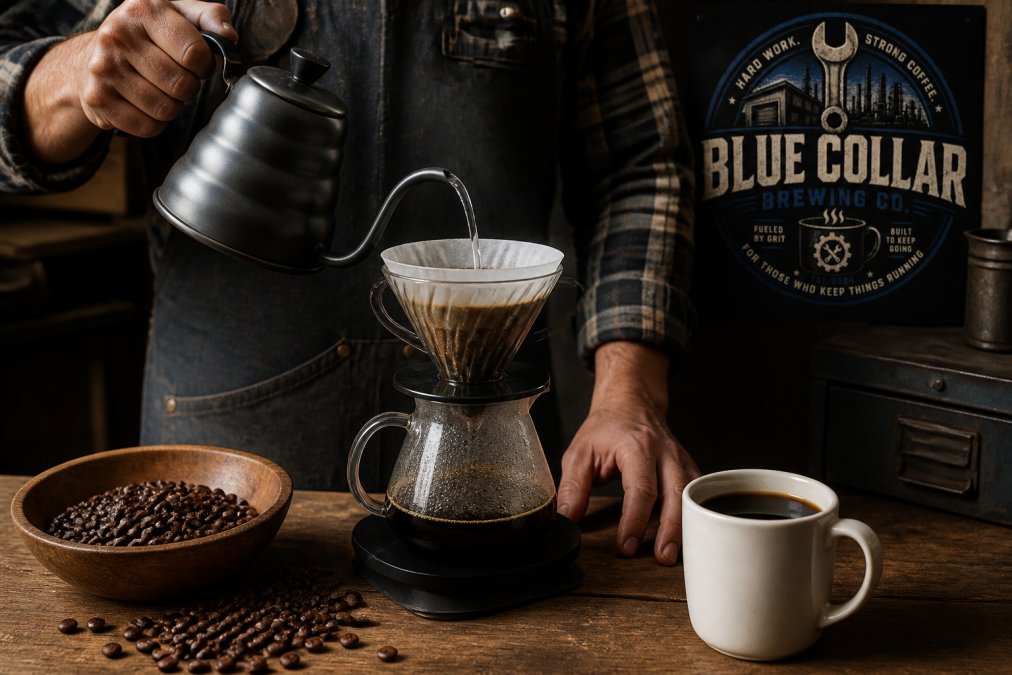
The paper filter removes oils, producing a clean cup.
French Press Brewing
French press is forgiving and bold.
Add coarse ground coffee and hot water. Use the 1:14 ratio for a stronger cup. Stir gently after 30 seconds to break up the crust of grounds on top.
Let it steep for four minutes. Press the plunger down slowly. The metal filter lets oils through, creating a heavier body and richer mouthfeel.
French press is good for beans with chocolate, caramel, or spice notes.
Drip Coffee Maker Method
Automatic drip makers are convenient but inconsistent.
Use fresh, filtered water. Add medium ground coffee. The 1:16 ratio works as a starting point.
The key is water temperature. Many cheap drip makers don't heat water hot enough. The coffee tastes weak and sour. A higher-end maker with temperature control solves this problem.
Troubleshoot Common Flavor Problems
Flavor problems are diagnostic clues. Once you understand what they mean, you can fix them systematically instead of guessing.
Sour or Weak Coffee = Under-Extraction
Under-extraction means water didn't pull enough flavor compounds. The coffee tastes thin, sour, or acidic.
Solutions: Use a finer grind (most common fix). Increase water temperature by 5°. Slow your pour so brew takes 3-4 minutes. Check bean freshness, stale beans are harder to extract.
Bitter or Harsh Coffee = Over-Extraction
Over-extraction means water pulled too many flavor compounds, including harsh tannins. The coffee tastes burnt, ashy, or unpleasantly bitter.
Solutions: Use a coarser grind (fastest fix). Lower water temperature by 5°.
Flat or Weak Coffee (But Not Sour)
Flat coffee tastes dull and lifeless. This usually means the coffee-to-water ratio is too low.
Muddy or Gritty Coffee
Muddy coffee tastes thick and unpleasant, with a grainy texture. Gritty coffee has visible sediment or particles.
Solutions:
-
Use a coarser grind for your method. If you're using a French press, use a coarse grind. If you're using pour-over, use medium-fine. If you're using a drip maker, use medium. Grind size must match the brewing method.
-
Check your filter. If you're using a metal filter (like in a French press), fine grounds slip through. Make sure you're using the right filter for your method. Paper filters catch fine grounds. Metal filters let them through.
-
Check your grinder. If your burr grinder is producing inconsistent particle sizes (some powder, some chunks), it's time to clean or replace it. Inconsistent grinds always taste muddy.
Inconsistent Flavor from Brew to Brew
If one cup tastes great and the next tastes off, the problem is inconsistency in your process.
Solutions:
-
Use a scale for coffee and water. Eyeballing measurements is the fastest way to inconsistency. A scale costs fifteen to twenty dollars and eliminates this variable.
-
Use a thermometer for water temperature. If you're relying on "boil and wait 30 seconds," temperature will vary. A simple thermometer costs five to ten dollars.
-
Time your brew. Use a timer. Brew time should be consistent. If one pour-over takes three minutes and the next takes five, your pour speed is inconsistent.
-
Use the same grind setting every time. If you're adjusting your grinder between brews, you're introducing variables. Dial in a setting and leave it.
Budget-Friendly vs. Pro-Level Gear
You don't need expensive equipment to brew better coffee.
A simple pour-over cone costs under ten dollars. A basic burr grinder costs thirty to fifty dollars. A kitchen scale costs fifteen to twenty dollars. That's the core setup.
Frequently Asked Questions
What is the best coffee to water ratio for home brewing?
The golden ratio is 1:16 (one part coffee to 16 parts water by weight). For example, 25 grams of coffee with 400 grams of water produces a balanced cup. Adjust between 1:15 and 1:17 based on your taste preference, stronger toward 1:15, lighter toward 1:17. A digital scale ensures accuracy better than eyeballing or spoon measurements.
How fresh should coffee beans be when you brew them?
Use beans roasted within 2-4 weeks for optimal flavor. Blue Collar Brewing roasts to order, so your beans arrive at peak freshness, check the roast date on the bag and brew within that window for maximum aroma and body.
What water temperature is best for extracting coffee flavor?
Brew between 195-205°F for optimal extraction. Too cold (below 190°F) causes under-extraction, resulting in sour, thin coffee. Too hot (above 210°F) causes over-extraction, creating bitter, harsh flavors. If your kettle doesn't show temperature, boil water and let it cool for 30 seconds. Consistency matters more than hitting one exact degree, aim for the 195-205°F range every time.
Why does my coffee taste bitter or sour?
Bitter flavor signals over-extraction: too-fine grind, water too hot, or steep time too long. Coarsen your grind, lower water temperature to 195°F, or reduce brew time by 30 seconds. Sour flavor signals under-extraction: grind too coarse, water too cool, or steep time too short. Grind finer, heat water to 205°F, or extend brew time. Taste changes help you dial in the balance between extraction and freshness.