

How to Keep Coffee Fresh When Ordering Online
Table of Contents
- Why Coffee Freshness Fades After It Ships
- How to Ensure Coffee Stays Fresh When Ordering Online
- Understanding Degassing Valves and Packaging That Protects Flavor
- Coffee Storage Best Practices for Peak Freshness
- How Long Does Coffee Stay Fresh After Roasting?
- Best Coffee Storage Containers and What to Look For
- Matching Batch Size to Your Crew's Drinking Pace
- Conclusion
- Frequently Asked Questions
Last Updated: September 25, 2026
Why Coffee Freshness Fades After It Ships
Coffee starts dying the moment it leaves the roaster. The culprit is oxygen. Once roasted beans meet air, oxidation begins stripping away the oils that carry aroma and flavor.
The clock starts ticking faster than most people realize. Whole bean coffee hits its peak within days of roasting, then declines steadily. Ground coffee? Even quicker, because more surface area means faster staling.
Here's what most guides get wrong: they tell you to check the roast date and stop there. But buying fresh coffee is only half the battle. How it's packaged, how fast it ships, and how you store it at home all determine whether that coffee tastes great or tastes like cardboard by week three.
At Blue Collar Brewing, we roast every batch to order. That means your coffee isn't sitting in a warehouse for months. It's roasted, packed, and shipped fresh. But even the best coffee needs proper handling after it arrives.
This guide covers the full picture: what to look for when buying, how packaging protects flavor, and the storage habits that keep your coffee tasting sharp.
How to Ensure Coffee Stays Fresh When Ordering Online
The best way to ensure coffee stays fresh when ordering online is to buy from roast-to-order sellers, choose fast shipping, and store beans properly once they arrive. Freshness depends on three factors: how recently the coffee was roasted, how well it's protected during transit, and how you handle it at home.
Check the Roast Date Before You Buy
The roast date tells you everything. A bag stamped with a date from last week will taste dramatically better than one roasted two months ago.
Look for the roast date, not a "best by" date. Best-by dates are vague and often set far in the future. A specific roast date tells you exactly how old the coffee is.
What to look for:
- Roast date within the past 7-14 days
- Whole beans instead of pre-ground
- Opaque packaging with a degassing valve
- A seller who roasts to order, not in bulk
Pick Fast Shipping and Roast-to-Order Sellers
Shipping speed matters more than most buyers think. Every day in transit is a day your coffee spends aging.
Roast-to-order sellers roast your coffee after you order it. That means it ships within days of roasting, not weeks. Combined with fast shipping, you get coffee at its peak.
A common mistake is choosing the cheapest shipping option to save a few dollars. Those extra days in a warehouse or truck cost you flavor. If freshness matters, pay for faster delivery.
Understanding Degassing Valves and Packaging That Protects Flavor
A degassing valve is a one-way valve built into coffee packaging that lets carbon dioxide escape while keeping oxygen out. After roasting, beans release carbon dioxide for several days. Without a valve, that gas builds up and can burst the bag or force air out when you open it.
The valve solves two problems at once. It releases pressure from inside the bag. It also blocks outside air from getting in.
Packaging features that protect coffee:
- One-way degassing valve for pressure release
- Opaque material to block light
- Airtight seal to keep oxygen out
- Nitrogen flushing to displace oxygen before sealing
Nitrogen flushing is worth understanding. Some roasters pump nitrogen into the bag before sealing. Nitrogen is inert, so it doesn't react with coffee. This pushes out oxygen and slows oxidation significantly.
Vacuum-sealed bags work differently. They remove all air, which stops oxidation but also traps carbon dioxide. That's why vacuum sealing works better for ground coffee or beans that have already finished degassing.
Coffee Storage Best Practices for Peak Freshness
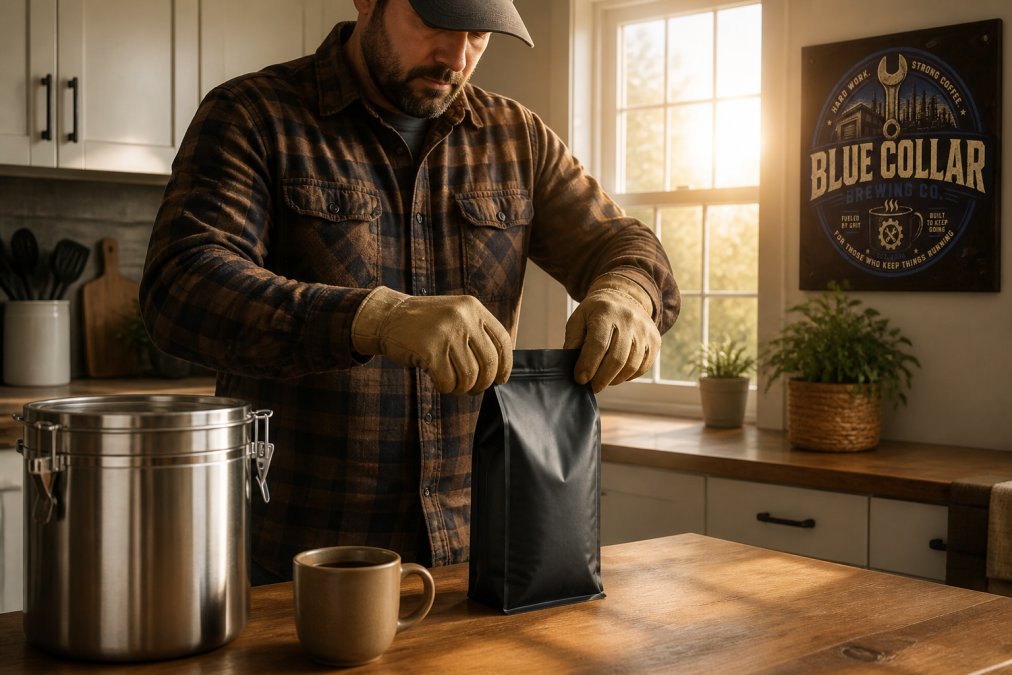
Store coffee in an airtight, opaque container at room temperature, away from heat, light, and moisture. This simple approach keeps beans fresh for weeks longer than leaving them in the original bag on your counter.
Avoid Heat, Light, and Moisture
These three enemies speed up the staling process faster than anything else.
Heat accelerates oxidation. Light breaks down the oils that give coffee its flavor. Moisture creates the perfect environment for mold and bacteria.
Keep your coffee away from:
- The stove or oven
- Direct sunlight
- The dishwasher or sink
- Any humid spot in your kitchen
A cool, dark cabinet near your coffee maker works well. Just make sure it's not above the stove.
Skip the Refrigerator, Try the Freezer Instead
The refrigerator is the worst place for coffee. Every time you open the door, temperature and humidity shift. Coffee absorbs moisture and odors from whatever else is in there.
The freezer is different. For long-term storage, freezing whole beans in an airtight container preserves freshness for months. The key is to freeze in small batches you'll use within a week or two.
Freezer storage rules:
- Use an airtight, opaque container
- Freeze whole beans, not ground coffee
- Take out only what you need
- Let frozen beans come to room temperature before grinding
How Long Does Coffee Stay Fresh After Roasting?
Whole bean coffee stays fresh for about 2-4 weeks after the roast date when stored properly. After that, flavor fades gradually. Ground coffee goes stale much faster, often within a week.
The resting period matters too. Right after roasting, beans need a few days to degas. Brewing too soon can produce uneven extraction and a flat taste.
Best Coffee Storage Containers and What to Look For
The best coffee storage containers are airtight, opaque, and sized to hold only as much coffee as you'll use in a week or two. Material matters less than the seal.
What to look for:
- Airtight seal to block oxygen
- Opaque body to block light
- One-way valve option for freshly roasted beans
- Right size for your consumption
Matching Batch Size to Your Crew's Drinking Pace
Buy only as much coffee as you'll drink within 2-3 weeks. This is the single most effective storage tip, but most guides stop there and never tell you how to actually calculate it.
A Simple Batch-Size Formula
Multiply your daily cups by the number of days in your freshness window, then divide by the cups-per-bag figure for the size you're considering.
- One person drinking 2 cups a day, 14-day window: 28 cups needed, so a 12-ounce bag is right-sized
- Two people drinking 3 cups each, 14-day window: 84 cups needed, so a 2-pound bag fits
- A job site crew of six drinking 2 cups each, 14-day window: 168 cups needed, so two 2-pound bags or one 5-pound bag
Why 'Too Fresh' Is Also a Problem
There's a counterintuitive wrinkle most guides skip: coffee can be too fresh. Right after roasting, beans release carbon dioxide in a process called degassing. Brew too soon and the CO2 interferes with extraction, producing a flat, uneven cup with a sour edge.
Different brew methods tolerate different rest periods:
- Espresso: needs 5 to 14 days of rest after the roast date. Too fresh and the shot gushes and tastes sharp; too old and it runs thin and bitter.
- Pour-over and drip: 3 to 7 days of rest is a common sweet spot.
- French press and cold brew: more forgiving, often fine at 2 to 5 days.
Splitting Large Orders the Right Way
For crews, ordering whole bean in bulk makes sense if you'll finish it within a few weeks. Split large orders into smaller containers when they arrive. That way you're only opening one container at a time, keeping the rest sealed.
The Takeaway on Batch Size
Batch size isn't just about saving money or avoiding waste. It's about matching your order to your brew method and your pace so every cup lands inside the freshness window. Do the math once, and you'll never wonder why your coffee tastes flat again.
Conclusion
Keeping coffee fresh when ordering online comes down to three things: buying from sellers who roast to order, choosing packaging that blocks oxygen and light, and storing beans properly once they arrive.
Frequently Asked Questions
How long does coffee stay fresh after the roast date?
Whole bean coffee hits peak flavor about 4 to 7 days after roasting and stays good for roughly 2 to 4 weeks in an airtight container at room temperature. Ground coffee stales faster, usually within 1 to 2 weeks, because more surface area is exposed to oxygen. If you order online, check the roast date on the bag and plan to finish it within that window for the best aroma and flavor.
Will coffee stay fresh in a Ziploc bag?
A Ziploc bag slows staling a little, but it does not seal out oxygen the way a purpose-built container does. Oxygen, light, and moisture all speed up oxidation, and a thin plastic bag offers weak protection against all three. Transfer beans to an opaque, airtight container with a tight lid, or keep them in the original bag with the degassing valve intact and squeeze out excess air before sealing.
Does freezing coffee beans actually keep them fresh?
Freezing works well for long-term storage if you do it right. Portion beans into airtight, opaque containers or vacuum-sealed bags, freeze them, and take out only what you need for the next few days. Let the container come to room temperature before opening so condensation does not form on the beans. Avoid repeated freeze-thaw cycles, which introduce moisture and flatten the flavor profile.
Should I buy whole bean or ground coffee for maximum freshness?
Whole bean stays fresh longer because the oils and aromatics stay locked inside the bean until you grind. Ground coffee exposes far more surface area to oxygen, so it stales faster, often within days once opened. If you order online and want peak flavor, buy whole bean and grind right before brewing. If you need convenience on a job site, an instant option like Blue Collar Brewing's instant coffee ($19.99 for 30 servings in a resealable pouch) keeps things simple without a grinder.