

Manual Coffee Brewing for Workers: 7 Benefits
Table of Contents
- Why Manual Coffee Brewing Matters for Your Workday
- Popular Manual Coffee Brewing Methods
- The Best Way to Brew Coffee at Work
- Coffee Brewing Equipment for Work Environments
- Manual vs Automatic Coffee Makers: What Workers Need to Know
- Flavor Control and Freshness: The Real Difference
- Cost Per Cup and Workplace Sustainability
- Caffeine, Energy, and Responsible Consumption
- Frequently Asked Questions
Last Updated: October 14, 2026
Why Manual Coffee Brewing Matters for Your Workday
Manual coffee brewing workers value isn't just about taste. It's about control, freshness, and energy when you need it most, whether you're starting a pre-dawn shift or taking a break between jobs.
Here's what sets manual brewing apart: you decide the water temperature, steep time, and coffee-to-water ratio. Automate it and a machine makes those calls. That control translates to better flavor, fresher coffee, and a ritual that works for your schedule.
Construction crews, maintenance teams, and logistics professionals, manual coffee brewing workers among them, who switched from convenience store coffee or automatic drip makers reported better energy, fewer afternoon crashes, and coffee that actually tasted like something. It's not complicated or expensive, and it makes a real difference in how you power through your day.
Below, we'll cover the most practical manual brewing methods for work environments, how to set up your station, and why fresh-roasted beans matter when coffee fuels a physically demanding job.
Popular Manual Coffee Brewing Methods
Manual coffee brewing methods give you flexibility automatic makers can't match. Brew at your desk, in a break room, or on a job site, no electricity or waiting for a pot, just hot water, grounds, and five to ten minutes.
Pour-Over Brewing
Pour-over is the simplest manual method. Place a filter and grounds in a cone or flat-bottomed dripper, then slowly pour hot water over them. Total time: five to eight minutes.
Why it works for workers: It's portable, a cone weighs almost nothing and fits in a truck or locker. It's also forgiving, the easiest way to start manual brewing, and the filter catches sediment for a clean, smooth cup.
The tradeoff is attention: you pour the water yourself and can't walk away. But many workers find that five-minute ritual a welcome break from the noise and movement of the job.
French Press
A French press is a glass or stainless steel cylinder with a metal mesh filter and plunger. Add coarsely ground coffee, pour hot water, steep four minutes, then press the plunger down. The whole pot brews at once for multiple cups.
Why it works for workers: Volume. A French press makes enough for four or more people, and a stainless steel press handles being thrown in a toolbox. The method is straightforward: add, pour, wait, press.
The downside is cleanup: the mesh filter leaves fine sediment, and you must rinse the press right after brewing, a hassle where water access is limited.
AeroPress
An AeroPress looks like a large syringe. Add finely ground coffee and hot water, steep one minute, then press the plunger to force water through a paper filter into your cup. It brews one cup in three to four minutes.
Why it works for workers: Speed and consistency. The paper filter produces a clean cup with no sediment, and the short brew time yields bright, energetic flavor, exactly what you want before a long shift.
The trade-off is single-serve: for a crew you're making multiple batches. Fine for solo workers or small teams; larger groups are better off with a French press.
The Best Way to Brew Coffee at Work
The best way to brew coffee at work depends on your setup, time, and crew size, but a few principles apply no matter the method.
Start with fresh-roasted beans. Stale coffee tastes flat and bitter, and whole beans stay fresh longer than pre-ground. Grind just before brewing. At Blue Collar Brewing, we roast every batch to order, so the beans are recent when they arrive.
Use the right water temperature. Too hot burns the grounds and tastes harsh; too cool under-extracts and tastes weak and sour. Aim for 195 to 205 degrees Fahrenheit, or let boiled water cool 30 seconds.
Match your grind size to your method. Pour-over and AeroPress use medium-fine grounds; French press uses coarse. A burr grinder gives you control; blade grinders are cheaper but less consistent.
Measure your coffee. A common ratio is one part coffee to 16 parts water by weight, or two tablespoons per six ounces without a scale. Once you find a ratio you like, stick with it.
Coffee Brewing Equipment for Work Environments
Your brewing setup should be simple, durable, and easy to clean at work. You don't need much.
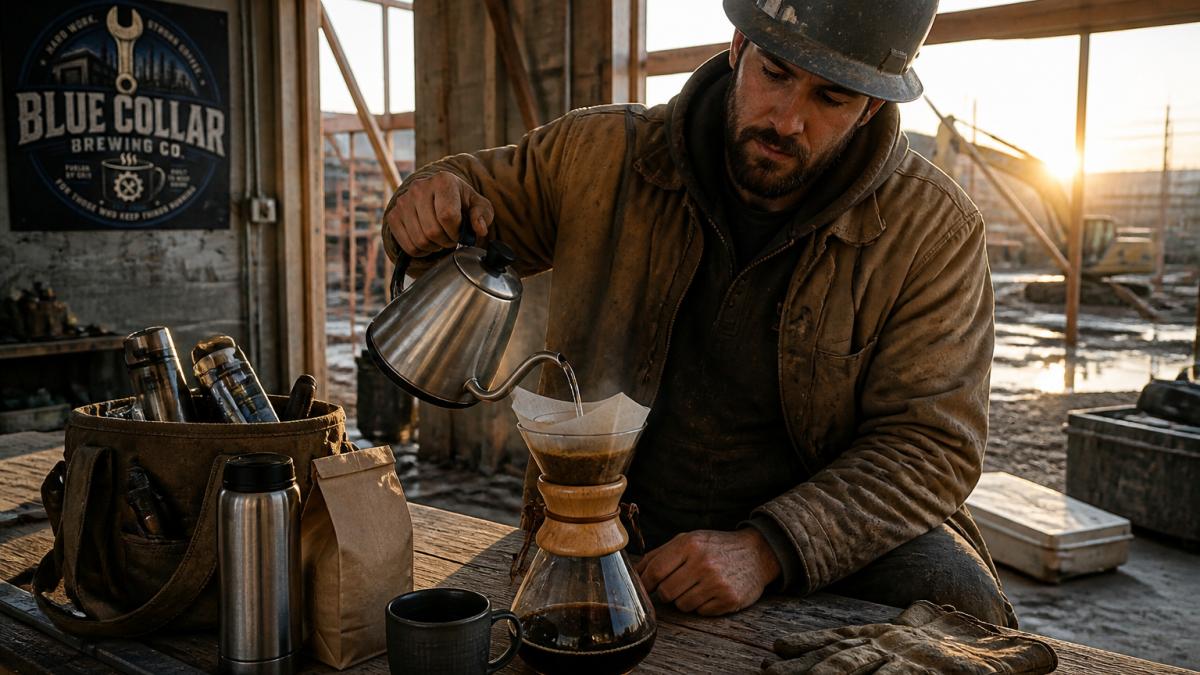
A grinder. A hand-crank burr grinder is affordable, portable, and needs no electricity; a small electric burr grinder is faster with an outlet. Avoid blade grinders, they heat the beans and produce uneven grounds.
A brewing vessel. Choose one that fits your workflow. A pour-over cone is lightweight and portable. A French press is durable and makes multiple cups. An AeroPress is fast and compact.
A kettle or water heater. An electric kettle heats water in two to three minutes; a stovetop kettle works anywhere. Some job sites have hot water in a break room. Know what you have access to.
A scale (optional but helpful). A small kitchen scale costs $15 to $30 and removes the guesswork. Many workers use volume measurements instead. Both work.
Filters. Paper filters for pour-over and AeroPress are cheap and disposable; French press metal filters are reusable. Keep extras on hand.
Start simple. A grinder, a pour-over cone, and a kettle brew better coffee than most convenience stores offer. Add equipment as you figure out what works for your routine.
Manual vs Automatic Coffee Makers: What Workers Need to Know
Automatic drip machines are convenient. You load grounds, add water, press a button, and walk away. Manual brewing requires attention and effort. So why choose manual?
Control. With an automatic maker, the machine controls water temperature, brew time, and how the water contacts the grounds. You get what the machine decides. With manual brewing, you control everything.
Freshness. Automatic makers often keep coffee warm on a hot plate. Heat breaks down the flavor compounds in coffee. Manual brewing produces a fresh cup immediately, then you drink it. No sitting around. No stale taste.
Flexibility. An automatic maker is tied to one location. It needs a counter, a power outlet, and a water source. Manual brewing works anywhere you have hot water. On a job site. In a truck.
Cost per cup. An automatic maker costs $30 to $100. Manual equipment costs $15 to $50. And manual brewing encourages you to use better beans.
The tradeoff is time and attention. Manual brewing takes five to ten minutes and requires you to be present. If you're in a rush or you want coffee ready when you walk in the door, an automatic maker wins.
For most workers, manual brewing is worth the trade. You get better coffee, more control, and a ritual that breaks up your workday.
Flavor Control and Freshness: The Real Difference
The biggest advantage of manual brewing is control over flavor. Every variable in the brewing process affects what's in your cup.
Grind size changes how fast water flows through the grounds. Finer grinds slow the water down, so the grounds steep longer and extract more flavor. Coarser grinds let water flow faster, so extraction is lighter.
Water temperature affects extraction speed. Hotter water extracts faster and pulls out more flavor compounds, including some bitter ones. Cooler water extracts slower and produces a lighter cup.
Brew time is how long the grounds and water are in contact. Longer brew times extract more flavor. Shorter brew times produce a lighter cup. A pour-over takes five to eight minutes. A French press takes four minutes.
Coffee-to-water ratio determines how strong your cup is. More coffee makes a stronger, fuller-bodied cup. Less coffee makes a lighter cup. Start with one part coffee to 16 parts water.
Bean freshness matters more than anything else. Stale beans taste flat and dull no matter how you brew them. Fresh-roasted beans taste bright and complex. Whole beans stay fresh for two to three weeks after roasting.
This is where Blue Collar Brewing makes a real difference. We roast to order, so your beans are never more than a few days old when they ship.
Cost Per Cup and Workplace Sustainability
Manual brewing costs less than you might think. And it's better for the environment than single-use cups and pods.
Equipment investment. A basic manual brewing setup costs $30 to $50. A hand-crank grinder ($20 to $30), a pour-over cone ($10), and filters ($5). You're done. That's a one-time cost. An automatic maker costs more upfront and breaks down eventually.
Bean cost. Quality beans cost more per pound than grocery store coffee, but you use less. A pound of beans makes about 16 cups. At $20 per pound, that's $1.25 per cup. A convenience store cup costs $3 to $5.
Long-term savings. If you buy coffee out five days a week, that's roughly $750 to $1,250 per year. Brewing at work with good beans costs $200 to $300 per year. The difference adds up.
Environmental impact. Single-use cups, pods, and disposable filters create waste. Manual brewing with reusable equipment and compostable filters is cleaner. You can compost used grounds. Paper filters biodegrade. Metal filters are reusable. Over a year, one worker brewing manually produces far less waste than buying coffee out.
For a job site or crew, the savings are even bigger. If ten workers each buy coffee out, that's $7,500 to $12,500 per year. A shared French press, grinder, and good beans costs a fraction of that.
Caffeine, Energy, and Responsible Consumption
Manual coffee brewing doesn't change the caffeine content of your coffee. A cup of brewed coffee has roughly 95 to 200 milligrams of caffeine, depending on the beans and brewing method (the FDA).
What changes with manual brewing is how you consume it. When you brew manually, you're more intentional. You're not just grabbing a cup. You're taking time to make something.
Timing matters. Caffeine peaks in your blood about 30 to 60 minutes after you drink it. If you drink coffee too late in the day, it can interfere with sleep.
Hydration. Caffeine is a mild diuretic, so it increases water loss. If you're doing physical work and sweating, you need extra water to stay hydrated. Don't rely on coffee alone. Drink water throughout your shift.
Jitters and crashes. Too much caffeine at once can cause jitters and anxiety. A crash can happen a few hours later when the caffeine wears off.
Alternatives. If you're sensitive to caffeine or you want to cut back, consider herbal tea or decaf coffee.
Manual coffee brewing for workers is about more than taste. It's about taking control of your energy, your breaks, and your routine. You get better coffee, save money, and build a ritual that works for your schedule.
Ready to upgrade your work coffee? Shop Coffee at Blue Collar Brewing and discover fresh-roasted beans roasted to order for maximum flavor and aroma. Our Breakfast Blend and Breakfast Blend + are built for workers who need reliable energy and genuine taste.

Frequently Asked Questions
What is the best way to brew coffee at work?
The best method depends on your break time and workspace. Pour-over takes 3-4 minutes and requires minimal cleanup, making it ideal for tight schedules. AeroPress brews in 1-2 minutes and fits in a locker or truck. French press delivers rich body but needs 4-5 minutes and careful handling on a job site. Choose based on your available time, water access, and how much equipment you can carry. Fresh-roasted beans like Blue Collar Brewing's Breakfast Blend enhance any method.
Is manual coffee brewing better than using an automatic coffee maker?
Manual brewing gives you control over grind size, water temperature, and brew time, variables that directly affect flavor extraction. Automatic makers are convenient but often brew at inconsistent temperatures and can't be adjusted. For workers who value flavor and freshness, manual brewing delivers noticeably better results. The trade-off is 3-5 minutes of hands-on time versus the set-and-forget speed of automatic machines.
How fresh is coffee roasted to order, and does it matter?
Coffee roasted to order is at peak freshness for flavor and aroma. Coffee sitting on store shelves for weeks or months loses volatile compounds that create the brightness and complexity you taste. Freshness matters significantly: you'll notice the difference in aroma, body, and how clean the cup tastes. Blue Collar Brewing roasts every batch to order, ensuring maximum flavor in every cup.
What equipment do I actually need to start manual coffee brewing at work?
At minimum: a grinder (burr grinder preferred for consistency), your chosen brewing device (pour-over, AeroPress, or French press), a scale or measuring cup, hot water source, and fresh whole beans. A gooseneck kettle helps with pour control but is optional. Most manual setups cost $40-$100 total and fit in a work bag or locker. Start with one method and add equipment as you refine your routine.